


In all socio-technical systems, there is a tension between autonomy and cohesion. Every system finds a way to deal with this tension, or it collapses if it fails to do so for long.
This essay is part of the Autonomy and Cohesion series, which includes an earlier one-dimensional version of the Cohesion Spectrum.
Autonomy is the capacity to make informed, uncoerced decisions. To keep the same term in purely technical domains, it must be understood also metaphorically. Since components are unable to make decisions, “autonomy” should be understood there as the degree of freedom or independence within the system.
Cohesion, in the context of socio-technical systems, is the action or fact of forming a whole or working as a whole. It is about forming a unity (static aspect) or acting in unison (dynamic aspect), where uni- (from unus, one in Latin) is the common for being one and acting as one. Due to the second, dynamic aspect, cohesion subsumes coordination.
The tension between autonomy and cohesion is also observed in the technical layer, shaping and being shaped by the tension in the social layer. There is an evolutionary trend toward increased decoupling, punctuated by setbacks.
Cohesion imposes constraints and reduces autonomy. Cohesion is due to natural forces and designed mechanisms.
Liquids and solids exist in their states due to cohesion forces binding molecules, such as van der Waals forces, dipole interactions, hydrogen bonds, and ionic bonds. Socio-technical systems exhibit analogous forces — though more complex, less understood, and largely beyond direct influence. That last property is what sets them apart from cohesion tools and technologies: tools are things we deliberately create and deploy. But once created, they act back on us, issuing imperatives their designers did not intend. The steam engine built to cut wood ended up organizing factories, cities, and labor.1 The distinction is not that forces shape us while tools do not. It is that forces are what we find ourselves within; tools are what we make, and then find ourselves within.
Personal cohesion forces include needs for safety, belonging, reduced uncertainty, self-esteem, and shared values, driving the formation of groups and organizations. Social identity further strengthens cohesion through identification with communities, professions, or beliefs, while emotions like loyalty or empathy may dominate in certain contexts. In social networks, self-expression, validation, and fear of missing out are key drivers.
Cohesion operates internally and externally. Within organizations, identity, dependencies, shared resources, and the pull of collective benefits such as efficiency bind elements together. Networks rely on proximity, transitivity, and shared interests. Externally, forces such as shared enemies or market pressures sustain cohesion despite internal tensions.
Cohesion tools and technologies – such as language, rituals, norms, and media – enable coordination. Language is central, self-producing, and generates other media. These tools vary in how they balance cohesion and autonomy, which they do alongside cultural and contextual factors.
Different cohesion mechanisms affect autonomy in two ways. Since cohesion imposes constraints, the cost of participation is always a loss of autonomy. However, some cohesion mechanisms also increase autonomy. In certain cases, the autonomy gain can exceed the autonomy cost. To account for the dual effect, autonomy should be represented as a two-dimensional vector: participatory and consequential autonomy.
Participatory autonomy is the operative discretion available to participants within a coordination regime. It is the actual autonomy range remaining after complying with the regime’s constraints. Operative discretion often differs from the formal one. An Amazon seller may formally be running their own business, but the commission rates, search ranking, return policies and delisting conditions are set unilaterally by the platform.
Consequential autonomy is the decision space made available to participants as a result of the coordination regime. When using HTTP, complying with the protocol’s request-response conventions is non-negotiable, but doing so grants access to the entire web, a decision and action space that did not exist before the protocol.
The Zones
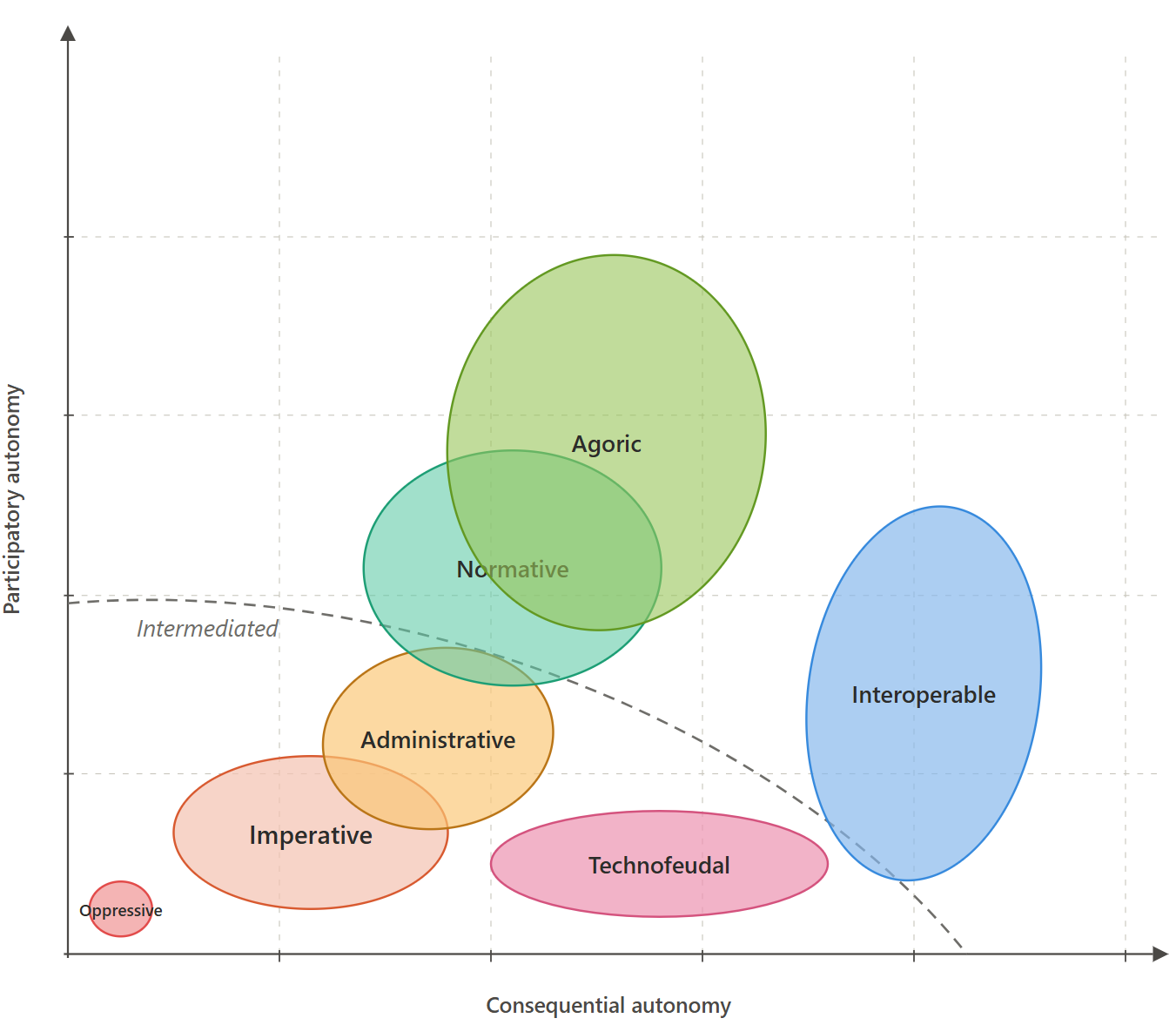
The ranges of participatory and consequential autonomy across different cohesion mechanisms cluster into several zones, some of which overlap.
Oppressive
Both participatory and consequential autonomy are compressed to functionally negligible levels. Physical force or legal non-personhood eliminates exit. Residual micro-decisions, such as the pace of work or small acts of solidarity, persist, but they cannot alter outcomes in any significant way, and the regime contributes nothing to participants’ decision space because it is organized around elimination rather than enablement. Unlike other zones, where an organization’s coordination footprint spans multiple mechanisms and zones (more on that later), oppressive regimes suppress alternative coordination so thoroughly that the footprint collapses toward a small region clustered near the origin. The origin itself functions as an asymptotic boundary: the theoretical endpoint toward which oppressive regimes tend as they intensify. Yet no real system reaches it, because doing so would require the complete elimination of the participant as an agent. Chattel slavery, Nazi concentration camps, and North Korean political prison camps are the closest historical approaches to that boundary.
Imperative
What varies considerably is consequential autonomy. A well-organized army provides logistics, collective intelligence, and operational reach that are unavailable to individuals. Feudal arrangements, though coercive, under the customary law (as opposed to the Roman law) gave the right to peasants to hunt and fish on the lord’s land. Early factory work sits higher still: wages with purchasing power, urban infrastructure, residual exit rights. The zone is wide on the consequential axis and flat on the participatory axis.
Coordination proceeds through issued directives. Deviation is sanctioned. Participatory autonomy is systematically constrained across all instances, not by any single explicit prohibition, but by the prohibitive cost of exit. A soldier in combat cannot leave. The situation is similar for a medieval serf. A nineteenth-century factory worker could, in principle, quit, yet only at costs that were effectively insurmountable. The mechanisms differ, but in each case, they converge on the same outcome: effective discretion remains low.
Administrative
Coordination through formal, codified, impersonal rules. Participants have operative discretion. A civil servant can exercise professional judgment, invoke appeals and interpret regulations. That discretion is bounded by procedure and accountability structures. The zone covers both government and private instances. The center of mass of nation-states and corporations, regulatory agencies and institutional churches is this zone. The relevant distinction is whether coordination proceeds through codified, impersonal rules enforced by procedure. When decisions are made by policy rather than identifiable persons, accountability dissolves.2
The rule of law is the core consequential contribution: property rights backed by institutional enforcement, contracts that will be honored, and the ability to challenge decisions through formal mechanisms. These expand what participants can decide and do beyond what they could manage in isolation.
Technofeudal
The Technofeudal zone shares the same low-participatory band as Imperative, at considerably higher consequential autonomy. The structural parallel is not metaphorical: the platform owner is a landlord. Participants bring their product, labor, or content. The platform unilaterally sets all terms and extracts rent for access. That’s why platforms that present themselves as marketplaces belong here, not in the Agoric zone. An Amazon seller cannot negotiate commission rates, search visibility, or return policy requirements. An Uber driver cannot negotiate fare rates or matching priority. A Facebook creator cannot negotiate what percentage of followers see their posts.
The term technofeudalism was coined by Varoufakis.3
Normative
Social pressure replaces formal enforcement. There is no arrest for norm violation, no algorithm enforcing ranking or manipulating feeds, no commander issuing directives. But exclusion is real and costly: loss of belonging, reputation, and access to shared resources. The enforcement mechanism is the community’s collective capacity to make participation costly for violators.
This zone has wide internal variance. A housing association restricts paint colors and structural modifications while delivering only shared maintenance and property value protection. A scientific discipline provides an accumulated body of methodology, a peer-review infrastructure, citation networks, and shared instrumentation that no individual could replicate. Self-managing organizations, worker cooperatives, and holacratic structures sit at the higher-participatory end.
Agoric
Coordination proceeds through price signals and counterparty choice. Participants can walk away, return tomorrow, offer a counterprice, and choose among alternative buyers and sellers. No single actor controls the terms of the encounter. A commodity trader routing orders across multiple exchanges, a bazaar vendor setting a price in anticipation of negotiation, and a freelance professional declining a client each exercise the high participatory autonomy that defines this zone.
The Agoric zone cannot stand alone. The Administrative-zone provides currency stability, contract enforcement, property rights, and competition policy.
Market-enabling intermediaries belong here, not in Technofeudal. A traditional stock exchange, a clearing house and an auction platform facilitate rather than control exchange. The principal test is whether participants can negotiate.
Interoperable
The dominant mechanisms of cohesion here are standards and protocols. Consequential autonomy stays very high throughout. Well-designed protocols create qualitatively new possibility spaces rather than improving access to existing ones. HTTP did not make existing communication faster: it made a global hyperlinked information space possible for the first time. The roundabout yield rule does not improve on traffic light performance: it enables drivers to negotiate gaps directly, simultaneously reducing fatalities and delays. The gain is categorical, not incremental.
Participatory autonomy varies widely within the zone. Some protocols leave no discretion. Any deviation from HTTP’s request-response format results in coordination failure. Others build in meaningful choices. The AT Protocol lets participants decide where to host their data, which moderation service to use, and which feed algorithm to adopt.
Protocols appear in other zones too. However, in the interoperable zone, protocols are the dominant mechanism, and not every class of protocol, but only the cautonomous ones, which means those with a high consequential/participatory autonomy ratio.
Clarifications
Freedom, Autonomy, Agency
Autonomy as choice may look like an overstatement in some systems or situations and an understatement in others. For example, in Decoupling and Rules on Graphs, autonomy is used as a proxy for degrees of freedom. In the Cohesion Spectrum, both the participatory and consequential dimensions are relevant not only to autonomy (what you can choose) but also to agency (what you can do).
Since all three concern distinguishable states available to a system, the issue of using autonomy when discussing degrees of freedom or action space can be easily resolved by applying Ashby’s concept of variety. It will dissolve the decision-space/action-space question since it is neutral between deciding and acting. It simply counts states regardless of whether they are decision states or action states. The additional benefit is the utilization of the Law of Requisite Variety.
And yet, sticking with autonomy has several benefits. The first is that autonomy as a concept is evocative and accessible. The second and more important benefit is that autonomy and cohesion name the lived experience of the tension: what it feels like to have latitude or to lack it, what it feels like for a group to hold together or to fragment.
Nominal and Effective Autonomy
Not all autonomy reductions or expansions are the same for each participant. Effective variety is the subset of nominal variety that is simultaneously accessible and relevant to the participant.
Three filters reduce nominal to effective: preference alignment (the most significant and elusive), capability and resources.
Preference alignment is about relevance. How much of the autonomy taken or expanded does the participant care about? A user with no preference over server governance, algorithmic transparency, or data portability experiences zero effective autonomy gain migrating from X to Mastodon or Bluesky, regardless of how significant the nominal autonomy expansion is. Conversely, a coordination regime that constrains only dimensions the participant was indifferent to anyway imposes zero effective autonomy cost. A strict dress code at work reduces nominal participatory autonomy but imposes near-zero effective autonomy cost on someone who would have dressed that way regardless. The preference filter operates on both axes: on Y, it determines whether the participatory cost is actually felt; on X, it determines whether the consequential gain is actually valued.
The second filter is participants’ cognitive, technical and practical competences that allow them to exercise the available action space. The consequential autonomy that the web provides is effectively zero for someone without literacy in any language with significant web presence.
The third filter is about participants’ resources. Unlike capability, they cannot be substituted by effort or learning alone. The web variety is effectively zero for somebody without connectivity or a subscription.
Preference remains the primary filter because it determines whether the other two constraints are even relevant.
Inter-Zone Relations
The bottom band shows a similar range for the participatory autonomy of classic feudalism and technofeudalism. The cost of coordination in both cases is different kinds of lock-in, but it suppresses participatory autonomy in a similar way. What the Amazon seller has that the medieval serf did not is consequential autonomy: global market access at scale.
Imperative, Administrative, and Technofeudal share a common structural property: coordination flows through intermediaries with concentrated agency. A dashed boundary separates coordination mechanisms organized around controlling intermediaries. Here, it is important to distinguish controlling from facilitating intermediaries. Organizations whose coordination footprints are dominated by controlling-intermediary mechanisms cluster below and to the left of this boundary; those using facilitating intermediaries or no intermediaries at all cluster above and to the right of it.
The Agoric zone’s dependence on Administrative is asymmetric: Administrative zones can exist without markets (e.g., central planning, theocracies), but markets cannot exist without Administrative infrastructure. Strip away contract enforcement and property rights, and exchange either retreats into the Normative zone (reputation-governed barter only) or gets captured by the most powerful participant, who becomes the platform — sliding across the Intermediated boundary into Technofeudal.
The Interoperable zone is not self-sustaining either. Its high consequential autonomy depends on Administrative infrastructure (standards bodies, dispute resolution, intellectual property enforcement) and Normative culture (the open-source ethos, cooperative standards development, shared technical values). Protocols emerge from communities.
Social systems are amoebas, not dots
Placing paradigm examples is a double edge sward. It helps clarify the zone and, at the same time, creates the impression that real social systems are dots on the plane. But neither are they dots, nor do they stay in the same position. Only in one case, the Oppressive zone, are they relatively small blotches. In all others, they are bigger blotches, but since they move, better to imagine them as amoebas. They have short-term vibrations and long-term transitions, which will get special attention in the next section.
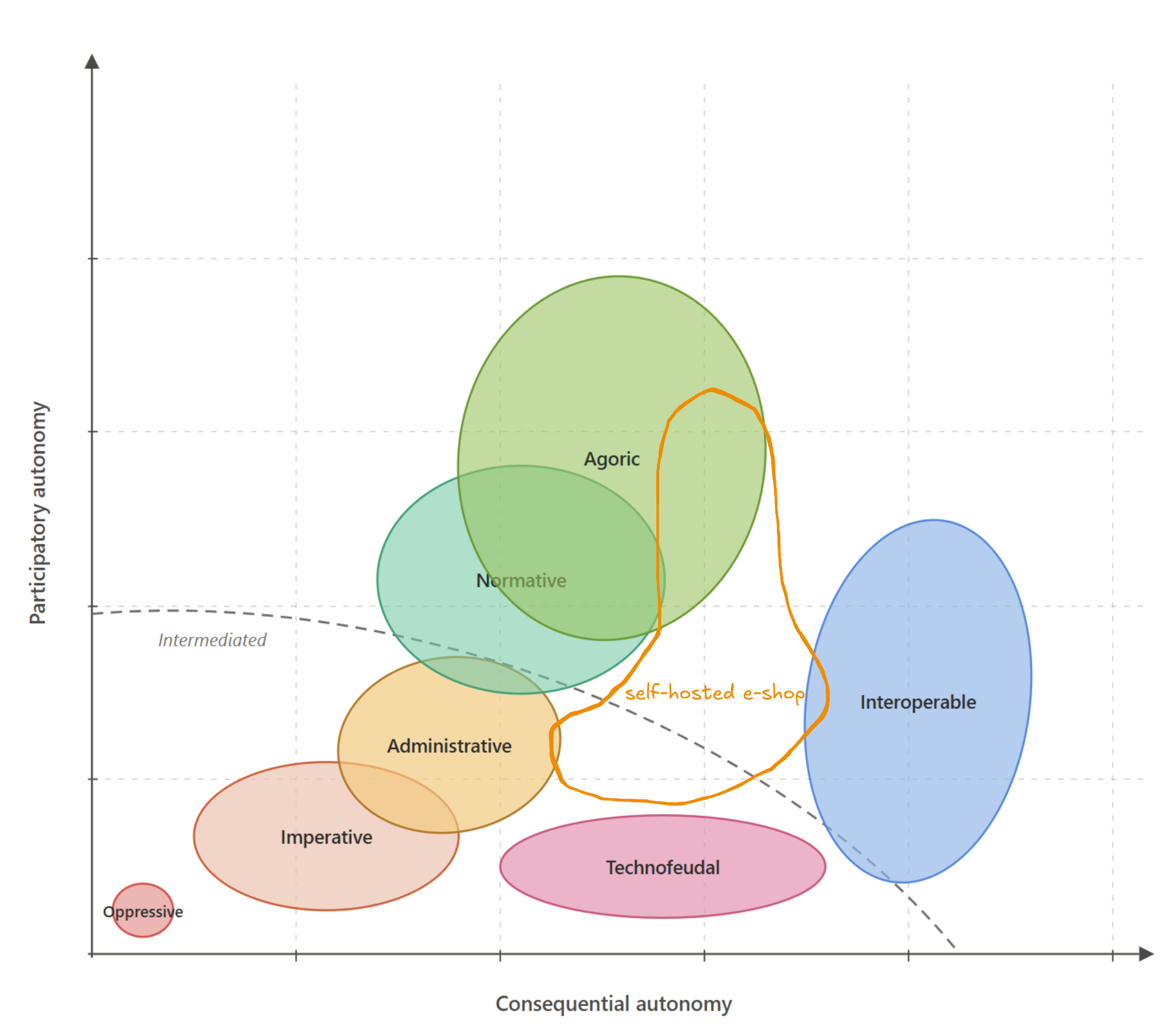
The autonomy plane maps coordination mechanisms, not organizations, communities, or networks. Any real social system deploys multiple coordination mechanisms simultaneously. A self-hosted e-shop uses HTTP (interoperable zone), negotiates directly with customers (agoric zone), and routes payments through Stripe (intermediated zone). And, as clarified earlier, they also depend on currency stability, contract enforcement, property rights, and competition policy (administrative zone). These are distinct mechanisms at distinct positions on the map. So, if we attempt to represent a self-hosted e-shop with all the cohesion mechanisms it brings and uses, it will look something like this:
Movement
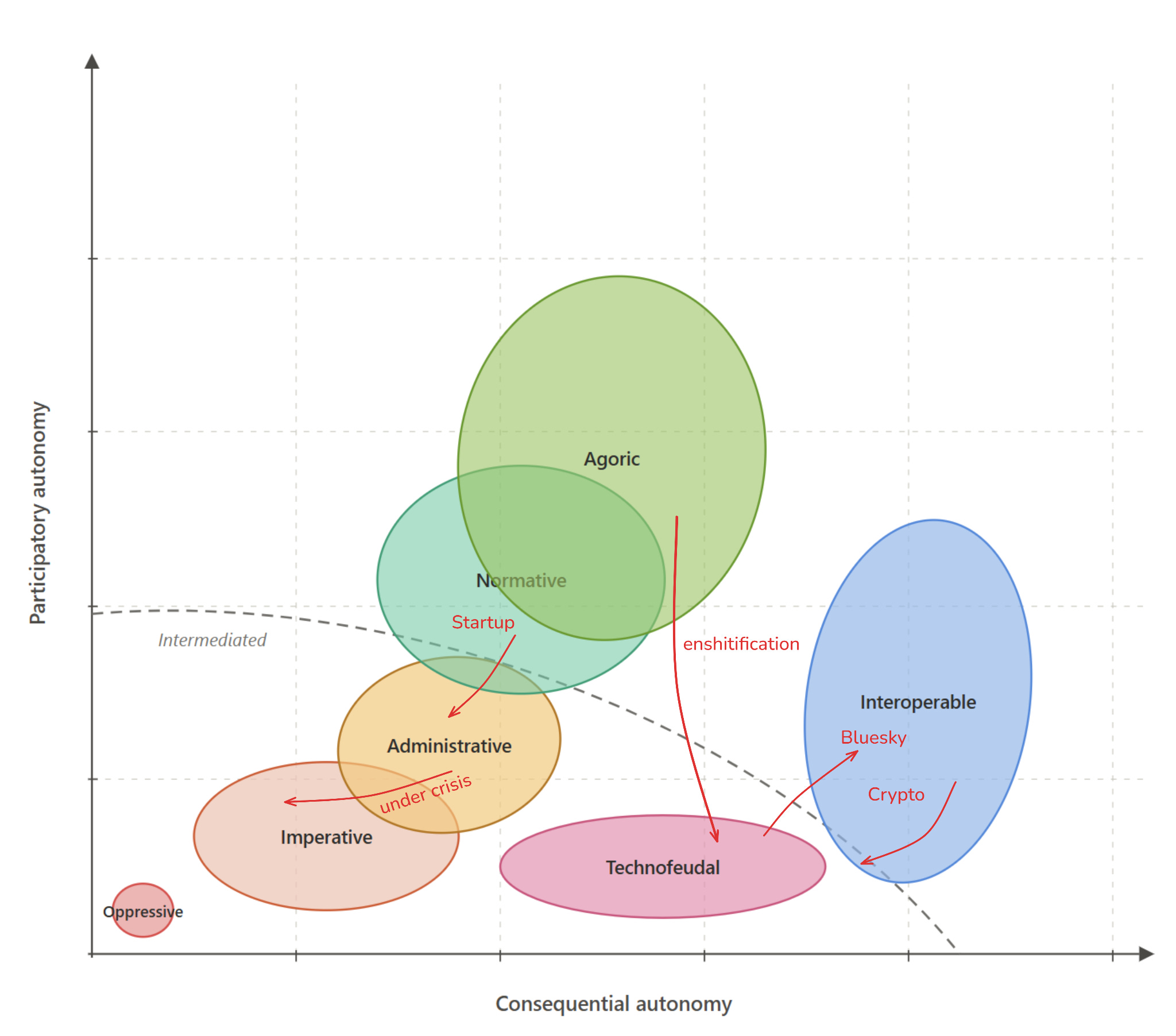
When startups scale, they move from Normative (shared mission, informal trust) toward Administrative (formal HR, legal, compliance). An Administrative organization under crisis slides toward Imperative as directive authority temporarily supersedes procedure, in different areas of the zone, depending if the crisis is war, natural disaster or pandemic. A professional community moves from Normative toward Administrative as it formalizes licensing and ethics codes. These trajectories are path-dependent and often irreversible.
Within the Interoperable zone, moving upward along it means achieving the same consequential expansion with more participatory flexibility. Protocols encode choices about how much discretion participants retain. Recent protocol design history can be read as a series of attempts to reclaim the agency that platform capture had extracted.
A notable movement in the Interoperable zone is that of the crypto ecosystem. It started as a desintermediation initiative with a peer-to-peer promise, but evolved differently. None of the protocols alone could address usability barriers, liquidity, scalability, and risk. As a result, some layers reintroduced intermediaries that closely resemble those of the fiat currency ecosystem in both roles and fee levels. There are payment wallet providers (custodian), payment gateway (like bank payment processors), smart contract platforms (clearing house), token launchpad (investment bank) and so on. So, from the middle of the Interoperable zone, the crypto ecosystem slides south-west into the Intermedates zone.
What drives these trajectories?
Coordination Rent
Startups move from Normative towards Administrative as they scale. Administrative organizations slide towards Imperative under crisis. Agoric regimes drift into Technofeudal under network effect pressure. There is a force driving these trajectories towards places with higher coordination rent. It pulls towards intermediary concentration.
Coordination rent names what happens in any coordination regime where whoever controls the coordination infrastructure can extract a rent from participants.
The mechanism is straightforward. As a regime matures, switching costs rise and alternatives become less viable. Participants become dependent on the regime’s outputs for their own planning. The controller’s capacity to extract increases, not because of any single decision, but because dependency is compounding in the background. Even with benign intent on the controller’s side, the structural conditions for higher extraction accumulate.
The rent is not always financial. In administrative regimes, the rent is procedural compliance. The civil servant does not pay the state in cash. They pay in the form they must fill, the appeal they must lodge, and the codified process they must follow. In normative regimes, the rent is conformity to group norms. The scientist pays in citations, methodological orthodoxy, and conference attendance. In imperative regimes, the rent is obedience. The soldier pays in the suspension of deliberation. In technofeudal regimes, the rent is some combination of all three, plus the financial component that platform economics makes visible.
Regimes on one side of the Intermediated boundary have an identifiable rent-extractor. Regimes on the other do not, which is why the Normative, Agoric, and Interoperable zones resist the gravitational pull in ways the others do not. The boundary is not a static feature. It is the line at which a coordination regime has accumulated enough intermediary concentration that rent extraction becomes structurally possible.
Named trajectories
Once the force is named, trajectories can be named. The Protocol Field4 identifies patterns like the Codification Trap and the Automation Drift.
Doctorow’s enshittification cycle is the obvious worked example. His three stages (good to users, then good to business customers, then extractive to both) map as a single trajectory. The regime begins near the Agoric zone with genuine counterparty choice and low switching costs. It crosses the Intermediated boundary into Technofeudal as network effects compound and coordination rent begins to accrue. The third stage is the regime fully occupying Technofeudal territory, with a residual minimum of value preserved only to prevent exit. The trajectory is predictable, empirically documented across multiple platforms, and in the public domain as a reference point that readers will recognize. It also demonstrates the asymmetry of the Intermediated boundary. The journey in is driven by compounding forces. The journey back out requires external intervention.
Thanks to Benjamin Taylor and Timber Stinson-Schroff for helpful comments on an earlier version.
Bryant, L.R. (2014) Onto-Cartography: An Ontology of Machines and Media. Edinburgh: Edinburgh University Press. Available at: https://edinburghuniversitypress.com/book-onto-cartography.html.
Davies, D. (2024) The Unaccountability Machine: Why Big Systems Make Terrible Decisions - and How The World Lost its Mind. Profile Books.
Varoufakis, Y. (2024) Technofeudalism: What Killed Capitalism. Vintage.
Grant, J.L. (2025) Introducing the Protocol Field Framework. IT Jobs Watch. Available at: https://github.com/johnlgrant-research/protocol-field