

At the PKM Summit earlier this month, I shared where I am on my journey towards serendipity protocols. The talk wasn’t recorded, but you can check the slides. On some of the shared topics, there are write-ups in the Serendipity series. On others not yet. One of those, for which there was no write-up during the talk, was the glossary, and I published it right after. Others are some practices. Among them is a seven-year-old one I call Today-is-later, which I mentioned in some essays in the series, and a recent experiment, Hot prompting. Today, I’ll explain one of the newer practices. I call it PIQ (pronounced like “pick”). PIQ stands for People, Ideas, Quotes.
Come together
The last entry in the Serendipity Glossary is thinging. Material engagement with objects helps thinking and enables tinkering. It’s even more basic than that. According to some school in cognitive science, cognition is not something that happens in the brain but emerges from active engagement with the environment.
Thinging means objects are active participants in thinking.
Writing on paper is already thinging. Like with the potters described by Malafouris (see references in the glossary), the shape is learned into existence. It is a path made in walking, to cite the famous line from Machado’s poem, the Wanderer.
Notes are often locked in their medium.
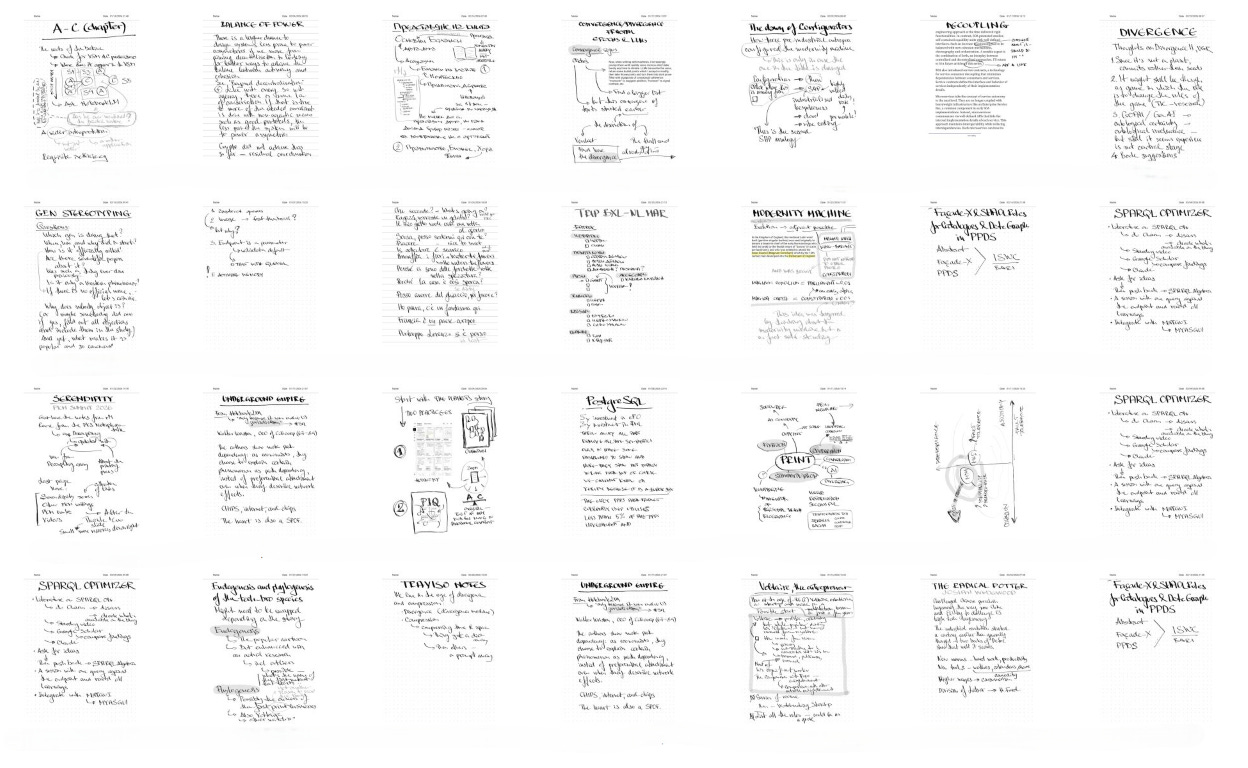
If there is a way to detach them, shrink them to palm size and print them on cardboard, we can play with them like with a deck of cards, shuffle them, draw several and put them side by side. These accidental neighbors can bring unexpected connections.
I haven’t done that yet, but I started experimenting with an electronic version of it. It’s too early to report results. What I’ll do instead is describe a similar practice, based on the same principle: unexpected neighbors occasionally trigger serendipitous events.
People, Ideas, and Quotes
What is common between Today-is-later, Graph Pruning, and PIQ is that a random sample of a particular type of notes appears on the daily note on certain days.
But while the first two deal with accumulation and entropy, the third one brings together items that can be generative on their own and potentially even more so when they come together in unexpected combinations.
Bringing unexpected people has already shown some serendipity in the Graph Pruning practice. The set of random pages may contain a person's node. That might be somebody I have been out of touch with for a while who has now resurfaced, and I want to catch up with. I’m tagging such cases with the path pattern to keep track. There have been sixteen such cases since July 2024, of which one (so far) has been an actual serendipitous episode. Not bad, but I thought I should make it more targeted and not on its own, but in combination with two other items: ideas and quotes.
And so, on certain days, an algorithm brings a PIQ block on my daily note, with a random sample of people, ideas and quotes pulled from my personal knowledge graph. Each item can trigger something on its own, but the greater potential comes when it appears alongside others in unexpected combinations. These combinations can occur in nine dimensions: three between same-type items, three between different items, and three more between each set and the context of the daily note on which it appears.
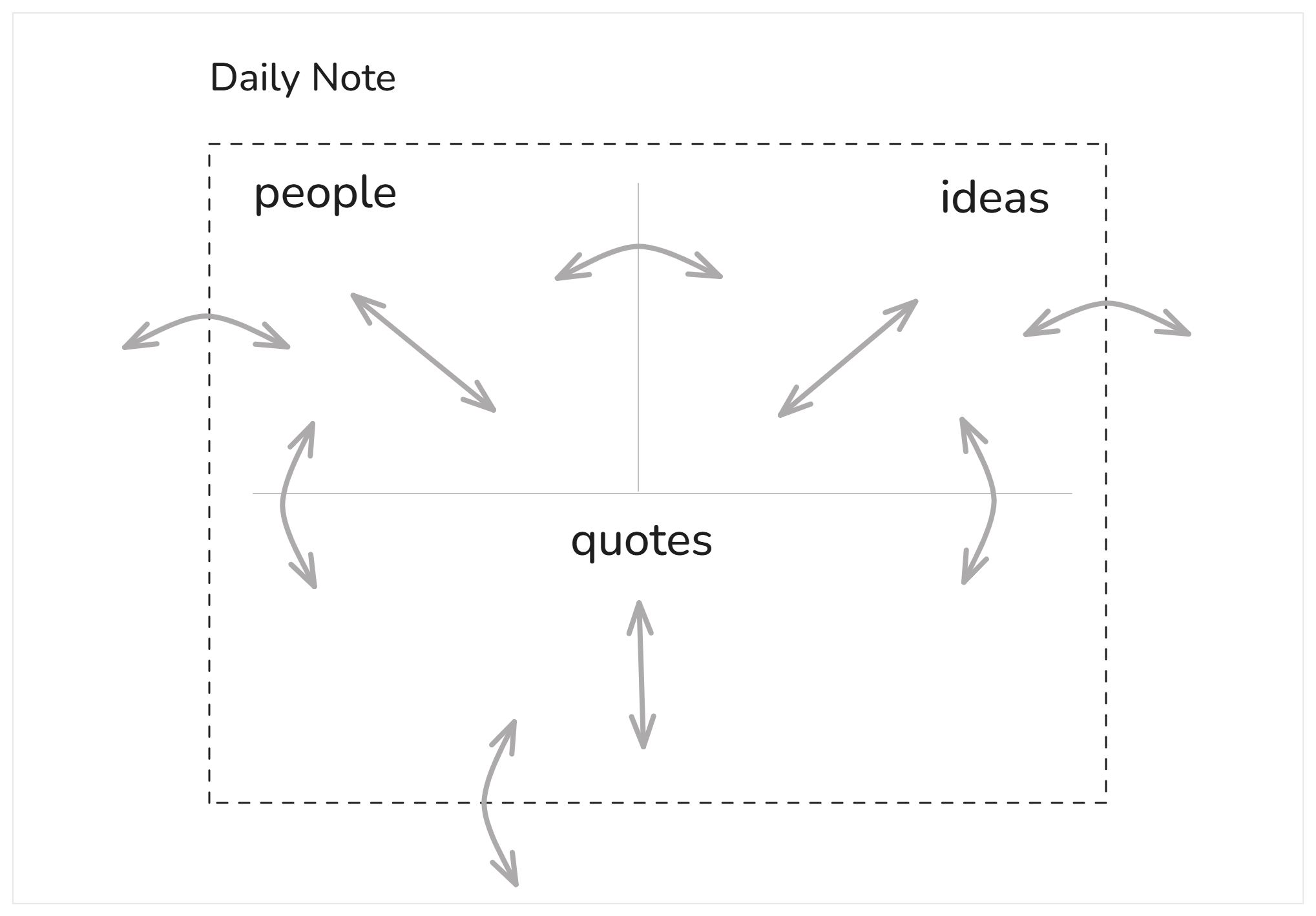
These sets of items appear naturally (I take care of their appearance on the page), but they are embedded query results, which means their context is a click away, and whatever they are connected to is just another degree further in the graph. The serendipity event an item may trigger may not come from the concrete one randomly pulled to my daily note, but from another item found in the exploratory journey that the pulled item invited me to take.
The potential for serendipity is high, but it doesn’t mean it will produce a happy accident every week or month. If there is one a month on average, that’s already a good result. But for this to work at all, it needs some critical mass. Currently, I have about 1500 people, 350 ideas and 4800 imported annotations. These numbers need some clarification.
From these 1500 people, I personally know less than a third. The rest appeared via Readwise, as authors of books, articles and papers I annotated. People I personally know are typed with a specific subtype, but for the PIQ practice, I prefer not to limit the pool only to them.
The pool of ideas in PIQ includes notes tagged as idea, thought or capture that have not been turned into anything else. Now I’m experimenting with adding those Bluesky posts and Substack notes, which I kept in my graph for resurfacing. This adds a few hundred blocks to the pool. More importantly, while other ideas would potentially trigger a serendipitous event of Penny pattern, the micro-posts also have the potential of Path. Here’s why. A forgotten post appearing in the daily PIQ block may be linked to new ideas I came up with in the meantime or to other items from that day. The reposting of that post with the new idea will resurface it in a new context together with a fresh idea, which may trigger a different reaction from the social network (now in a new state!), potentially a happy accident. One can’t step twice in the same river. That’s why it is a combination of random and living patterns.
If you practice some flavor of the Zettelkasten method, PIQ can complement your ideas distillery practice. You can even extend the idea pools with your zettels.
In my case, the quotes are all annotations from Readwise. If you have a quote captured manually or from another pipeline, it would be good to add them in the pool. The bigger the better. While in PIQ, I call them quotes, they are often a combination of a highlight and my note about it, which makes it more potent, if not for serendipity, then at least for linking and distillation.
I’m still experimenting with the numbers and frequency, and unlike Graph Pruning, PIQ hasn’t stabilized. The current samples are five people, two ideas, and three quotes. It runs on Tuesdays and Thursdays, and on weekends. The weekend is often ignored.
In all cases, the PIQ block is automatically deleted after a couple of days, unless there was a logged serendipity event, which then remains as the only child block of PIQ. The quotes part of PIQ appears on its own under a different parent, Today’s highlights on Monday, Wednesday and Friday.
The technical implementation of PIQ is simple. Yet, if you want to give it a try, you need to find the best way for it to fit your tool and workflows. With so potent coding agents around, it won’t be any challenge. For those who use Roam Research, I have described my implementation in the next section.
