

Making sense of what’s happening in the world is hard. That’s not for the lack of theories and opinions about it. But they just contribute to the overwhelming amount of other stimuli.
One coping strategy is to step back (the world is a historical thing after all) and choose more carefully what to pay attention to (not always to follow historians' choices).
Such attempts may result in seemingly weird statements. In an earlier essay, I proposed praising Voltaire not just as an Enlightenment philosopher and a playwright, but also as an entrepreneur. As such — and here I made an even weirder suggestion — he should be listed among other pre-industrial entrepreneurs, such as Jakob Fugger and Josiah Wedgwood. A staggeringly rich banker, interested solely in money-making above anything else, a potter who scaled through industrial innovation and influence branding, and a satirical writer who campaigned for social justice make an unlikely trio. Sounds like a joke: a German, an Englishman, and a Frenchman walk into a bar.
But they did enter, not into a bar but into the Modernity Machine and when they left, that machine was working differently.
So, these three were not just successful entrepreneurs. They are among the more significant engineers of modernity. Two of them also made an early contribution to the Divergence Machine that is replacing the Modernity Machine in our present day.
The Modernity Machine
At some point in history, there was a tremendous shift in how the world worked. For millennia, it was defined by bloodlines, a static sense of fate and divine mystery. And then it turned into a world defined by money, agency, measurement, and public opinion.
According to some, it happened suddenly. According to others, it took centuries. According to some, the main shift was towards secularisation of society, or what Max Weber called disenchantment. There are commentators who focus on the awakening of the arts, and others on the birth of modern science. For Bruno Latour, it was the start of pretending science and politics don’t mix, which allowed us to mix them more effectively.
Most accounts of modernity focus on one area of life, such as religion, economics, politics, or science. That gives a partial picture. In contrast, the Modernity Machine thesis is a systemic view that pays sufficient attention to the role of technology and to the evolution of class relations. Like Luhmann and Latour, it decenters humans.
Machine sounds mechanistic. The opposite of organic, some may say. But that’s a matter of interpretation. The best definition of life that I know of comes from the theory of autopoiesis. It treats the organism, the cell, and different levels of organisation, such as the nervous or immune systems, as autopoietic machines. And the embedding doesn’t stop at the level of the organism. In Principles of Biological Autonomy, Varela wrote:
If one says that there is a machine 𝑀 in which there is a feedback loop through the environment, so that the effects of its output affect its input, one is in fact talking about a larger machine 𝑀′ which includes the environment and the feedback loop in its defining organization.
If machine can be seen as equivalent to system, why not call it the modernity system? Well, the machine metaphor lends itself to useful engineering descriptions such as development, installation, configuration, upgrade, release, put into operation, phase-out, and so on. It also helps to see the characteristics and dynamics of an epoch as a civilization-scale contraption.
The Modernity Machine thesis was developed by Venkatesh Rao in a series of essays starting with this one. It sees modernity as a machine, constructed between 1200 and 1600 (a few centuries earlier than the mainstream theory has it). The early machine operated in parallel while the medieval machine was phasing out, and it still works today on its final day, while a newer one is being turned on.
The Modernity Machine functions through restructuring the relations between four classes: the monarch, the oligarchy, the technocracy, and the workers. The balance of power shifts towards previously weaker parties. There are often setbacks, but the trend persists. The previously suppressed class gains persistent new agency. I tried to sketch that in my notebook:
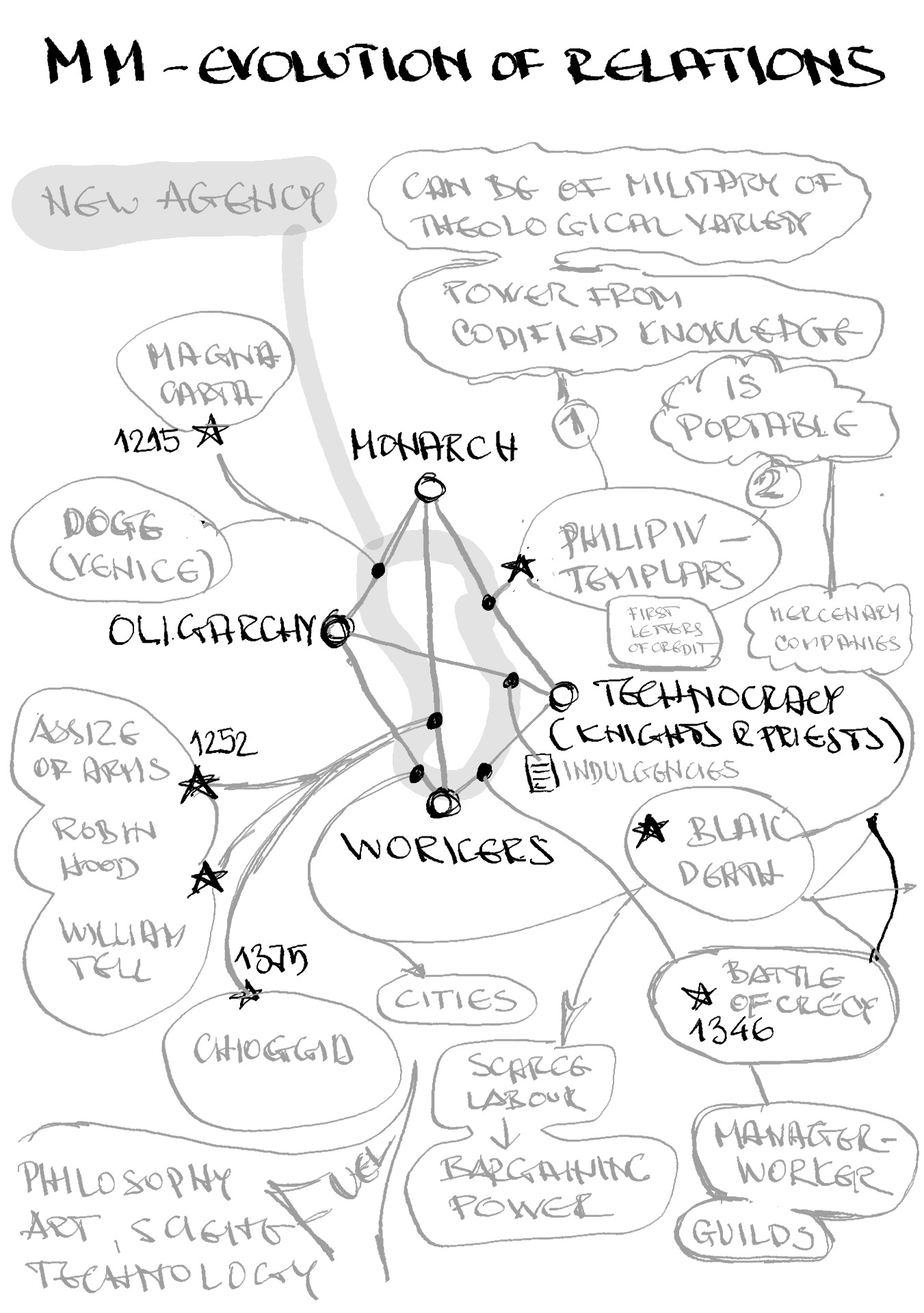
The Modernity Machine optimized for legibility. To control space, time, people, resources, goods and money, they had to be made readable.
The Power is Shifting
Jacob Fugger (1459-1525) was a merchant who pivoted from textiles to mining. At some point, he also added spices to his portfolio. But what made him rich and influential was his banking business.
How rich? His overall wealth reached 2% of GDP of Europe. Brought to our day, he would be richer than Musk and Bezos.
How influential? He influenced the elections of the emperors Maximilian I and Charles V. Being Maximilian’s main creditor for all his military operations, weddings and other projects, Fugger was in a position to influence European politics.
By his time, the Modernity Machine was already in development, and some upward social mobility was by then possible. Still, the society was strictly split into nobility, clergy, and commoners. Merchants were second-rate commoners, after patricians. For a commoner to become an oligarch solely through money was new. And Fugger went a big step further. He transformed the monarch-origarch relationship from one of divine right to a contractual relationship of creditor and debtor.
For Fugger, monarchs were not just debtors but partners in resource monopolization. He secured his loans by getting leasing rights to mine silver and copper. The demand for copper at that time increased due to other workings of the Modernity Machine: intensified trade (increased demand for coins) and the shift to artillery warfare (cannons were made of bronze, which contains mostly copper).
The oligarchy’s relationship with technocracy co-evolved with the latter’s changing composition. To manage his vast bank network, Fugger needed accountants, auditors, and lawyers. This way, Fugger and other merchants and bankers contributed to the proliferation of new roles in technocracy. It both reflected and accelerated the shift from military or theological knowledge to portable, codified knowledge.
Three centuries later, another pre-industrial entrepreneur, Josiah Wedgwood (1730 – 1795), turned pottery into an industry and pioneered modern marketing. Josiah Wedgwood transformed social relationships as a brander, taste-maker and disciplinarian.
By securing the title “Potter to Her Majesty,” which he used in his leaterhead he seduced oligarchy into buying his “Queen’s ware.” With this, a change in monarch-technocracy relations catalysed a change in oligarchy-technocracy relations.
Queen Charlotte wasn’t the only monarch whom Wedgewood targeted for influence marketing. The other was Catherine the Great of Russia. He made for her an exquisite dinner and dessert service of 944 pieces.
Once monarchs use such goods, they signal prestige, and nobles want a piece of that prestige too. Once nobles want it, wealthy merchants seek to signal that they share the same taste as the nobility. Wedgwood boosted consumer society through a cascade of desire. Masses bought, elites amassed.
The increased demand was caused by other societal changes, both in taste and in means. Regarding taste shift, one example should suffice. Once drinking tea became cool in the island, and the whole economy was on the rise, so more people could afford it, the demand increased so much that the tea imported from the East India company rose from £14,000 in the early 1700s to near £1 million in the 1760s, and then doubled by the end of the century.
Regarding the ability to afford it, the entire economy was growing, supported by and supporting the recently valued principles of hard work and the new tools for measurement and planning. Households shifted from provisioning for themselves to contributing to the marketplace. Wages increased. Women and children joined the workforce for the first time.
The third relation that Wedgwood shifted was that between technocracy and workers. He introduced the division of labour, which Henry Ford later refined. In this case, the shift was not towards reduced worker agency. Previously, one potter would make a pot from start to finish. Now every worker was specialized and replaceable.
Voltaire (1694 – 1778) brought a completely different transformation of monarch-technocrat relationships. With significant wealth, achieved through lottery hacking, business investments and money lending, he bought his independence so that he couldn’t be silenced or starved. He transformed the old model of the intellectual (monarch-technocracy relationship) from a subservient court pet to a negotiated celebrity. Importantly, while he could operate outside the patronage, he made sure to remain embedded in elite networks and exploit them.
Voltaire transformed the technocracy-oligarchy relationship in a similar way to the way Fugger transformed the oligarchy-monarch relationship: by becoming a creditor to the ruling class.
Voltaire influenced the transformation of the oligarchy-worker relationship by eventually supporting the Genevian natifs (initially siding with the patricians) and, through his Ferney enterprise, providing them with a platform to grow as independent watchmakers.
His influence in increasing the agency of a previously weaker class is probably most pronounced in his campaigns for penal reform. Public opinion and secular reason started to hold the system accountable.
Legibility is Eating the World
The Modernity Machine optimized for legibility. To scale something, you need to control it. And to control it, you need to be able to read it, measure it, and order it.
Fugger was exceptionally well-informed. His life is a notable example of early data-driven decision-making in business. The data had to be reliable, timely, interoperable, and consolidated.
He made sure that the data is reliable in terms of capturing and accuracy. In every branch office, every transaction was monitored and diligently recorded. The recording system was first made reliable by using double-entry bookkeeping, which Fugger learned in Venice. Second, Fugger made it reliable by pioneering the use of auditors.
Fugger made sure the information was timely by creating his private information network. Often, he was informed before rivals and monarchs.
The practice of double-entry bookkeeping was closely related to another Italian innovation, virtual money transfer. Fugger scaled up the new practice of transferring money by making corresponding entries in the respective branches, without physically moving money, which, apart from being faster, was also safer by avoiding the risk of road robberies.
And speaking of novel information management, he introduced something that could easily be seen as a precursor to today’s ERP and core banking software systems. Italian banks maintained separate statements for individual branches. A merchant could not survey their entire enterprise or know their total net worth at a glance. Fugger was the first to implement a consolidated financial statement from all his branches.
If Fugger was the master of financial legibility, Wedgwood advanced industrial legibility. Before him, the kiln was illegible and unpredictable. There was no way of knowing the temperature inside the kiln. Initially, he considered using the color change as a proxy, but it proved unreliable. He then started experimenting with measuring the relative shrinkage of a clay gauge. This Wedgood device was one of the first pyrometers.
Like Fugger, Wedgood understood the importance of diligent information capture. He meticulously recorded his experiments in commonplace books. For many of these recods he used codes to protect his findings.
Wedgeood rendered workers’ time legible through a timetable and a primitive clock-in system.
He also made his brand and offering legible. Wedgeood was the first to use illustrated catalogues.
Like Fugger, Wedgewood understood the importance of financial legibility. By introducing a primitive cost accounting system, he realised that the effect of fixed costs can be reduced by producing high volumes.
By securing royal patronage, Wedgewood converted fashion into a legible market signal.
Voltaire and Wedgwood lived in the century following the Peace of Westphalia, which kicked off the formation of the modern nation-state. The state was busy making its contents manageable. It created legibility by implementing simplifications and standardizations that converted complex, diverse local practices into a uniform administrative grid. This project aimed to provide officials with a synoptic view from the centre to streamline taxation. The concrete measures were the creation of surnames, the standardization of weights and measures, and, most remarkably, the creation of a cadastre. By linking a person to a piece of land, the state replaced complex ownership systems that had naturally evolved to deal with uncertainty with a simple one that made land ownership legible to the new bureaucracy.
And while the state was massively making people legible to the state, Voltaire took the first steps toward making the state legible to people. The French legal system was characterized by intense secrecy, with trial records often withheld from the public. Voltaire campaigned for justice reform both through direct requests for revealing the records and through fiction. He authored fictionalized yet factual narratives to expose procedural flaws in cases like the Calas affair.
Voltaire sought to render science legible to a wider audience by writing a book on Newton's theories, starting a tradition that dominates nonfiction today.
In a similar way as the printing press made knowledge reproducible independent of context, Voltaire made his own influence portable. Depending on how you define “celebrity,” you may put him as the third after Erasmus and Martin Luther. But if we define “celebrity” as someone whose private life, personal opinions, and physical likeness are consumed as a commodity by a broad public, then Voltaire was the first European celebrity.
Commits to the Divergence Machine
While all three engineered the Modernity Machine to a significant extent, Wedgewood and Voltaire did so after the machine was already switched on. So unlike Fugger, they also made some — if you allow me a Git metaphor — commits to the Divergence Machine. It wasn’t the start of its development. The first and most feature-bearing commits were made already by Spinoza. Now, in the century of Wedgwood and Voltaire, there were notable contributions and symptoms of a new world model, made quietly in the background of the noisy modernity machine.
The Divergence Machine (constructed 1600–2000) is a world machine that replaces the Modernity Machine. While the Modernity Machine optimised for legibility, homogeneity and convergence, the Divergent Machine spawns variety and proliferation. And to continue with the software development metaphor, treating bugs as features is its normal operating mode.
The Divergence Machine does not seek to subvert the Modernity Machine; instead, it brackets it, rendering centralised control irrelevant by creating civilizational space beyond its reach. This machine requires operators to live in ontological doubt, avoiding the modernist error of premature commitment to existing moral or ideological schemes.
While Josiah Wedgwood and Voltaire were engineers of the Modernity Machine, they also made notable contributions to the development of the Divergence Machine (especially Voltaire).
For Wedgwood, progress was a matter of tinkering. He relentlessly experimented. Although some of it directly contributed to his business, it shows an early sign of the shift from progress as material plenty to progress as growth of instrumental knowledge.
Wedgwood participated in the multi-disciplinary Lunar Society. As Lovell Edgeworth put it (as cited by Tristram Hunt — see the reference at the end), they gathered to share ‘the first hints of discoveries, the current observations, and the mutual collision of ideas.’ It was a dynamic pluralist discourse used to make sense of the expanding scope of experience.
Voltaire, on the other side, attacked dogma with absurdity.
In Candide, Voltaire mercilessly parodied Leibniz’s optimism, which argued that this was the “best of all possible worlds.” By ridiculing the idea of a prefigured moral ideology, Voltaire shifted the understanding of progress from a theological certainty to an evolving argument grounded in messy reality.
His campaigns for tolerance were early steps in creating a civilisational space for plurality.
P.S. In case I made them look like heroes
The world-as-contraption thesis, featuring the Modernity Machine (aka Convergence Machine) and the Divergence Machine, is about evolving relations between humans and technology and how that shapes society, politics, and the economy, and about the roles of art, science, and philosophy in those dynamics. Essentially, it is not human-centric. Yet, when listing the contributions of three “engineers,” I might have inadvertently made them heroes. Let me fix this a bit.
First, it’s three engineers, among many, not the three engineers. These people made something notable, which attracted information-gathering, which, when published, increased their notability and attracted more work that further increased their notability — a reinforcement loop with a similar effect to preferential attachment in networks. There might have been bigger contributors who were not that lucky or were simply quieter.
And second, they were no saints, far from it.
Fugger was interested in money-making above all, and everything was just a means to make more money. The only social project was the Fuggarei, which is often cited as the first social housing project. But it was, in fact, Feudalism 2.0 at the dawn of capitalism. Today, we have the techno-feudalism of Amazon and Alibaba (what should that be, Feudalism 5.0?).
Fugger financed the bloody suppression of the German Peasants’ War, an event that resulted in the deaths of 100,000 people.
Wedgwood became known as an abolitionist, especially for his famous anti-slavery medallion, yet his business depended on the production of sugar. The 18th century sugar economy was driven by the slave trade.
Voltaire often changed his public position to serve his personal interests. In a previous essay, I already mentioned two such cases: his change in position regarding Turkey and taxation. But there are more. To secure membership in the Académie Française, he wrote letters to prominent churchmen (whom he usually mocked) claiming to be a “true Catholic” and asserting that his writings were “sanctified by religion.” He even performed a public Easter communion, admitting to friends that he did it to “edify” his neighbors, while they viewed it as blatant hypocrisy. Voltaire congratulated Frederick the Great on a treaty that abandoned France’s interests. When this provoked a scandal over his lack of patriotism, he tried to mend his reputation by offering himself to the French court as a diplomatic spy. After his humiliating fall from favour in Prussia, Voltaire replaced all the letters he had written to his niece with forged ones to dramatize his side of the story.
In short, people are complicated, and the world is messy. That messiness was a bug for the Modernity Machine but is a feature for the Divergence Machine.
References
Steinmetz, G. (2015). The Richest Man Who Ever Lived: The Life and Times of Jacob Fugger. Simon & Schuster.
Davidson, I. (2012). Voltaire. http://pegasusbooks.com/books/voltaire-9781605981192-hardcover
Hunt, T. (2023). The Radical Potter. https://www.penguin.co.uk/books/299911/the-radical-potter-by-hunt-tristram/9780141984629
Rao, V. The Modernity Machine series: Part 1, Part 2, Part 3
Rao, V. The Divergence Machine series: Part 1, Part 2
Latour, B. (1993). We Have Never Been Modern (C. Porter, Tran.). Harvard University Press. https://www.hup.harvard.edu/books/9780674948396
Max Weber’s “Science as a Vocation.” (n.d.). Routledge & CRC Press. Retrieved February 24, 2026, from https://www.routledge.com/Max-Webers-Science-as-a-Vocation/Lassman-Velody-Martins/p/book/9781138980600
Luhmann, N. (2012). Theory of Society, Volume 1 (R. Barrett, Tran.; 1st edition). Stanford University Press.
Varela, F. J. (2025). Principles of Biological Autonomy (E. A. D. Paolo & E. Thompson, Eds.; a new annotated edition). MIT Press. https://mitpress.mit.edu/9780262551403/principles-of-biological-autonomy/ (Original work published 1979)