

Voltaire is often listed among the leading Enlightenment thinkers, alongside Montesquieu and Locke. Or he is mentioned among famous playwrights, such as Molière and Racine. But it’s unlikely to see Voltaire listed among successful entrepreneurs.
Yet at 76, he founded a startup and turned it into a successful international business.
Background
Voltaire wasn’t planning to start a business, nor did he need to. His interests were in writing, theatre, and political causes such as penal reform. He had plenty of revenue streams;1 he didn’t need another. However, his experience in financial management and the circumstances under which the idea was born might make the endeavour less surprising than it first appears.
Prior investment experience
In 1729, with the help of his friend, the mathematician Charles Marie de la Condamine, Voltaire took advantage of a loophole in the state lottery system. The prize value was miscalculated, so it was much higher than the total price of the lottery tickets. Winners also had other benefits. If they held government bonds that were devalued at that time, they could be repaid at the original issue price. According to some estimates, Voltaire earned half a million livres from this chicanery.
Another successful financial operation that year was the speculation with shares issued by the duc de Lorraine. Since these particular shares can only be purchased by the citizens of Lorraine, Voltaire had to prove some lineage. His perseverance made up for the far-fetchedness of his proof. In a letter of September 1729, Voltaire wrote:
After my pressing requests, they let me subscribe for fifty shares, which were delivered to me a week later. I immediately took advantage of the popularity of these new shares, and tripled my money.
These two cases were followed by others.
Apart from speculative and business investments (e.g., he invested in a company that supplied the military), much of his steady income came from lending money at interest.
Other startups
The watchmaking wasn’t Voltaire's first manufacturing startup. A few years previously, he set up a small silk business. Since he was previously engaged in agriculture, literally cultivating his garden, a statement he famously ended Candide with, it seems he just moved to the adjacent possible. While he did so more out of a need for something to cheer him up (at that time, he separated from his niece for the first time in sixteen years) than out of necessity, his silk business, as the subsequent watchmaking, shows his affinity for vertical integration. Voltaire’s silk business started with raising silkworms, but did not stop at producing silk. He also produced silk stockings.
Circumstances
When Voltaire fell out of favour with the French court, he bought an estate at Ferney, on the French-Swiss border, not far from Geneva.
In eighteenth-century Geneva, power was held by patrician families. Ordinary citizens and artisans (natifs) had limited rights. This situation caused numerous conflicts and escalated in the 1760s. French intervention and a military blockade in 1767 temporarily resolved the issue. But the patricians later rescinded the agreement, leading to a wave of violence in early 1770.
At that time, Voltaire initiated the transformation of a nearby fishing village, Versoix, into a trading port to reduce his dependence on Geneva for his supplies. Such a project could also benefit France, for which he convinced the French Prime Minister, Duc de Choiseul, who promised to support it financially.
Voltaire believed that dissatisfied natifs would be willing to move there and build a life away from their oppressors in Geneva. And indeed, quite a few were ready to move, which further angered the Genevan patricians, who were already worried that their local trading and political dominance would be challenged by a new French trading port.
In the meantime, some protesters fled Geneva and were given French residence permits. Since they couldn’t move to Versoix — the project town was not yet built — many settled in Ferney and its surroundings.
It so happened that the French government was facing financial difficulties and couldn’t begin the promised investment in Versoix.
Voltaire realised that many of the emigrants were skilled craftsmen. So, while waiting for the Versoix to be built, he can help them start a business as independent watchmakers.
Watchmaking Business
That’s how the Ferney startup took off as something between a social enterprise and a business incubator.
Quick facts:
Craftsmen: from 40 in 1770 to 600 in 1773
Revenue: from 450K (1775) to 600K (1776) livres
Markets: Spain, France, Russia, Turkey, Holland, Italy, Algeria, Tunisia
Voltaire established the watchmaking business at Ferney as a social enterprise. Without losing its role as such, the startup grew into a successful business selling watches in more than eight markets and, at its peak in 1976, generated revenue of 600K livres annually, equivalent to ten million euros today.
These extraordinary results were almost entirely due to Voltaire’s personal efforts, for he had reinvented himself in a protean variety of roles: not just the overall manager, co-ordinator and organiser but also the financier, the virtual bank manager, the sponsor, the builder of homes and factory space, the buyer of precious metals and other raw materials and the international sales manager.2
Voltaire realised that businesses are most vulnerable at the outset and created the most favourable conditions for production: housing for watchmakers, tax exemptions, and interest-free financing, which he supplied himself.
He turned the theater in his house into a watchmaking workshop. In a letter to the marquis de Jaucourt, Voltaire wrote:
Our theatre auditorium, which you remember, has been transformed into workshops. There, where we once recited verse, we are now melting gold and polishing cogs. We must build new houses for the emigrants. All the workers of Geneva would come here if we were in a position to house them. We must remember that everyone nowadays wants a gold watch, from Peking to Martinique, and that there used to be only three great manufacturing centres, London, Paris and Geneva.
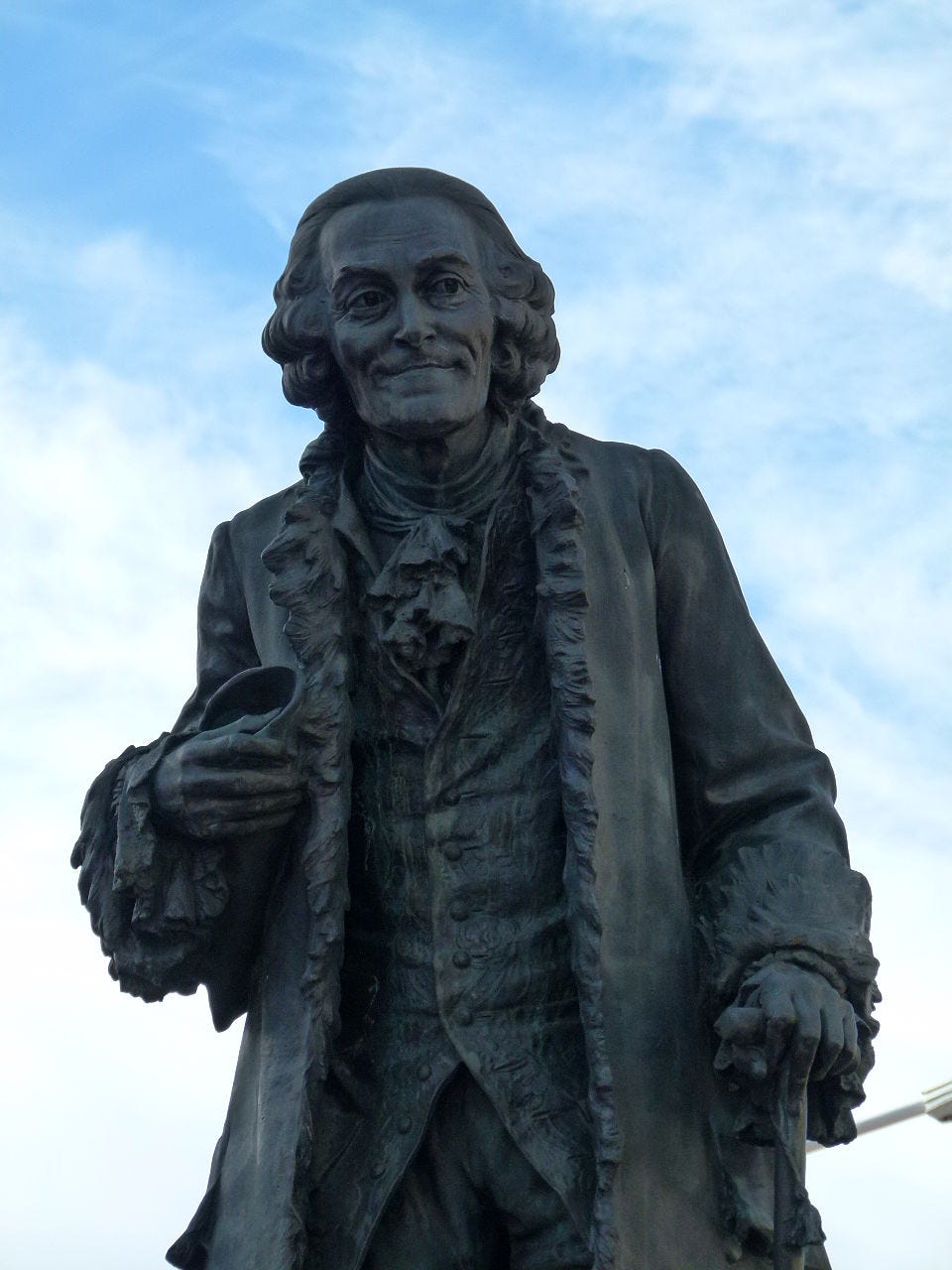

In the same letter, he expressed pride in his religious tolerance achievements:
Sensitive and tolerant souls will be happy to learn that sixty Huguenots live so well with my parishioners, that it would not be possible to guess that there are two religions here.
Alongside his efforts to secure government protection and supplies, Voltaire began seeking customers through his social network. Given the high profiles of his contacts, he achieved good initial results. But he soon realised it wouldn’t scale and started looking for sales representatives. In some cases, like Spain, his efforts succeeded; in others, like Rome, they failed.
The sales situation in Russia and Turkey is particularly interesting. While the Russian market was a good example of strong sales volumes achieved by exploiting the admiration of a single, very rich fan, Catherine the Great, the business in Turkey was conducted through trade representation in Constantinople. The case is interesting as an example of how commercial interests prevail over ideology. While Voltaire had previously enthusiastically supported Catherine’s military operations against Turkey, the successful trade with Turkey now reversed his position.3
Voltaire’s change of position regarding Turkey is rather typical. There was a similar case with taxation. As mentioned earlier, to help the business, he lobbied and achieved a tax exemption. That was easier to defend when the business was growing, and its survival depended on it, but less so later, when it became profitable. Tax farmers, learning of the prosperity in Ferney, tried to get their share. For Voltaire, achieving tax exemption was relatively easy with the previous finance minister, who was his friend, but less so with the new one. And yet he managed to negotiate it. This time, however, tax farmers demanded compensation.
After some successful mediation, Voltaire helped secure an agreement. For the first year, he personally financed the agreed compensation. But then, his reputation as an excellent mediator between the tax authorities and the local population led the Estates-General to appoint him as a tax advisor. Now, Vortaire, who had previously fought for tax exemptions for the watchmakers, proposed a progressive tax regime to finance future compensations, so the rich watchmakers would pay more than the poor peasants.
It’s worth noting that, despite his advanced age and his multiple roles in keeping his watchmaking enterprise running, Voltaire continued to write plays.
Regarding the Ferney watchmaking, it’s quite plausible that, like most entrepreneurs nowadays, Voltaire planned to sell it at some point. In a letter from 23 of December 1775, he wrote:
I am convinced that our property will double in price within a year.
The business reached its peak in the summer of 1776. Then it started to decline. The investment in building new houses to accommodate the growing colony started while the tax exemption was in effect. But now, there was a new finance minister, who restored both the suspended land tax and the required community labour for road maintenance. While this pushed some watchmakers away from Ferney, the business continued for a few decades after Voltaire's death in 1778.
In the list of entrepreneurs
If Voltaire has to be listed, not only among prominent Enlightenment figures and famous playwrights, but also among successful pre-industrial entrepreneurs, who else will belong to that list?
I would nominate Jakub Fugger and Josiah Wedgwood. Although the three of them differ in the size of their businesses, wealth, and business models, they are comparable in how they contributed to the development and operation of the modernity machine. I’ll elaborate on this in another essay.
Writing royalties wasn’t one of them. Although he was a prolific and popular writer, Voltaire did not earn much from his literary output. The reasons for that include the lack of copyright laws, piracy, and censorship (many of his books were banned, and some were publicly burned). To bypass censorship, Voltaire had to publish anonymously or abroad. And in some cases, such as with the Comédie-Française, he simply stopped claiming his author’s rights.
Davidson, I. (2012). Voltaire. http://pegasusbooks.com/books/voltaire-9781605981192-hardcover
This reminds me of the Venetian Republic’s appeal to the Pope to trade with the Muslim world, made four centuries earlier.