

Two things are certain in life: death and dependency. But, as Epicurus wrote:
death … is nothing to us, because as long as we exist, death is not present, and when death is present we do not exist.
In contrast, dependencies are present at all times.
This is another essay in the Autonomy and Cohesion series.
Both autonomy and cohesion can be defined through dependence:
Dependency slope
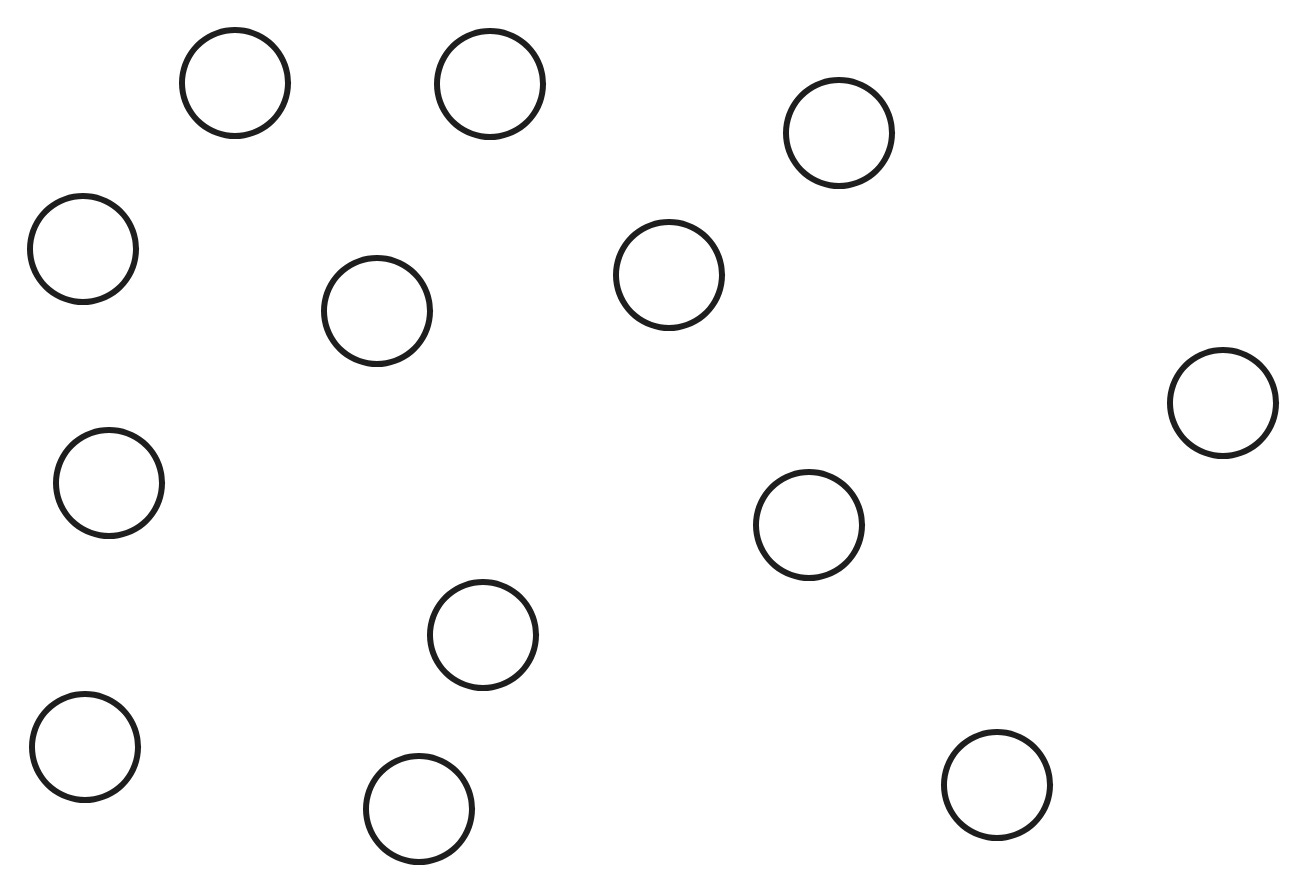
Autonomy looks like this:
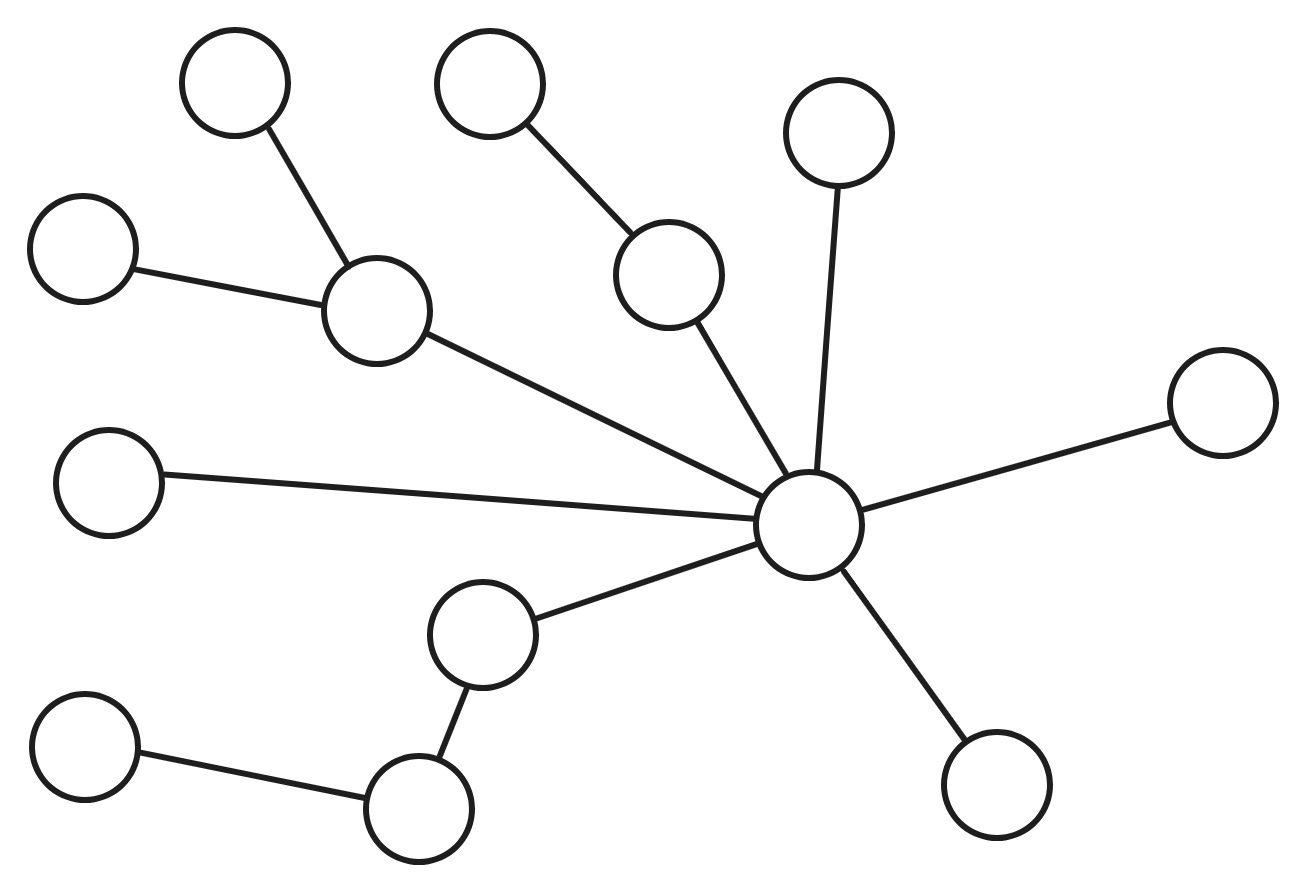
And cohesion looks like this:
But at a closer look, it’s always rather like this:
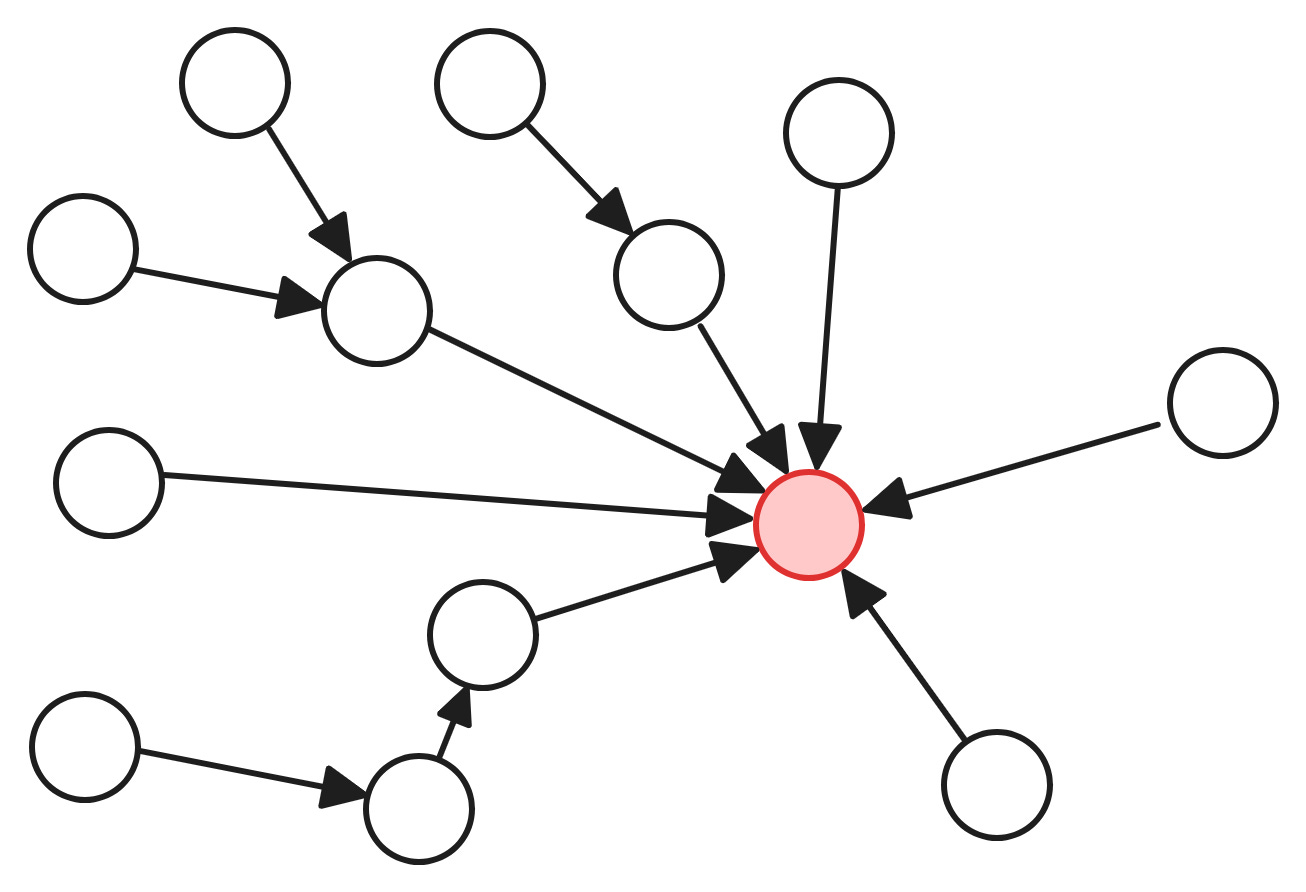
It’s a directed dependency graph, and such that all the edges (shown as arrows above) lead to one or a few power nodes (shown as circles above). The graph has a slope. Levi Bryant then has a point in treating power as gravity. And so has Luhmann, who saw power not as held by somebody but as a medium. Both avoided an anthropocentric treatment of power.
When cohesion is drawn as a dependency graph, it’s easy to see the direction of each edge showing the dependency, and the overall slope towards one power node. But you may live in this medium for a long time without seeing the slope. The international transaction system looked like this: a shared pool with no power concentration for a long time, until a sanction cut off a whole country out of it, like the US cut off Iran in 2012, forcing a huge oil-based economy to be reduced into barter trade. I’ll come back to this kind of dormant dependency shortly.
Dependencies are not always unidirectional. But even when mutual, they are often asymmetrical.
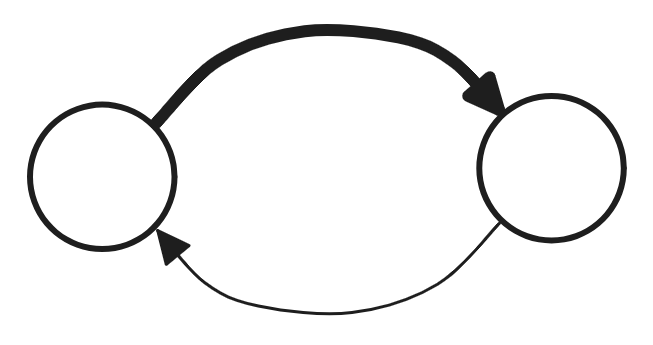
You depend on the morning train more than the train depends on you. The corner shop depends on its bank more than the bank depends on it.
Autonomy on lease
You don’t pay a subscription fee for using the alphabet. It is not just free to use: once you learn to read and write, nobody can take away your literacy. That’s free autonomy. Here, free is both as in free beer and as in freedom, and they are connected: there is no rent to pay for free autonomy because you are unbound.
By contrast, autonomy on lease is held for as long, and on whatever terms, an owner allows. But what do you pay for the lease?
An earlier essay in the series elaborated on the way cohesion mechanisms work. Each takes some participatory autonomy and potentially gives some consequential autonomy. That clusters the different ratios ranges of autonomy cost/gain into seven zones. To participate in a coordination regime, participants pay coordination rent — financially, as procedural compliance, or as conformity to group norms.
It is that coordination rent which is the cost of the lease.
Rent is not a feature of all leases, though. A chokepoint may have a deliberate owner who extracts from it and can hold it shut, or it may be an accident no one designed and no one is billing for. The Intermediated boundary on the autonomy plane marks precisely that difference. It does not divide leased from not leased. The Intermediary boundary divides an unarmed lease, an accidental chokepoint with no owner by design, no rent, and usually little staying power, from an armed one, where a deliberate owner can hold the node and charge for the privilege of passing through it.
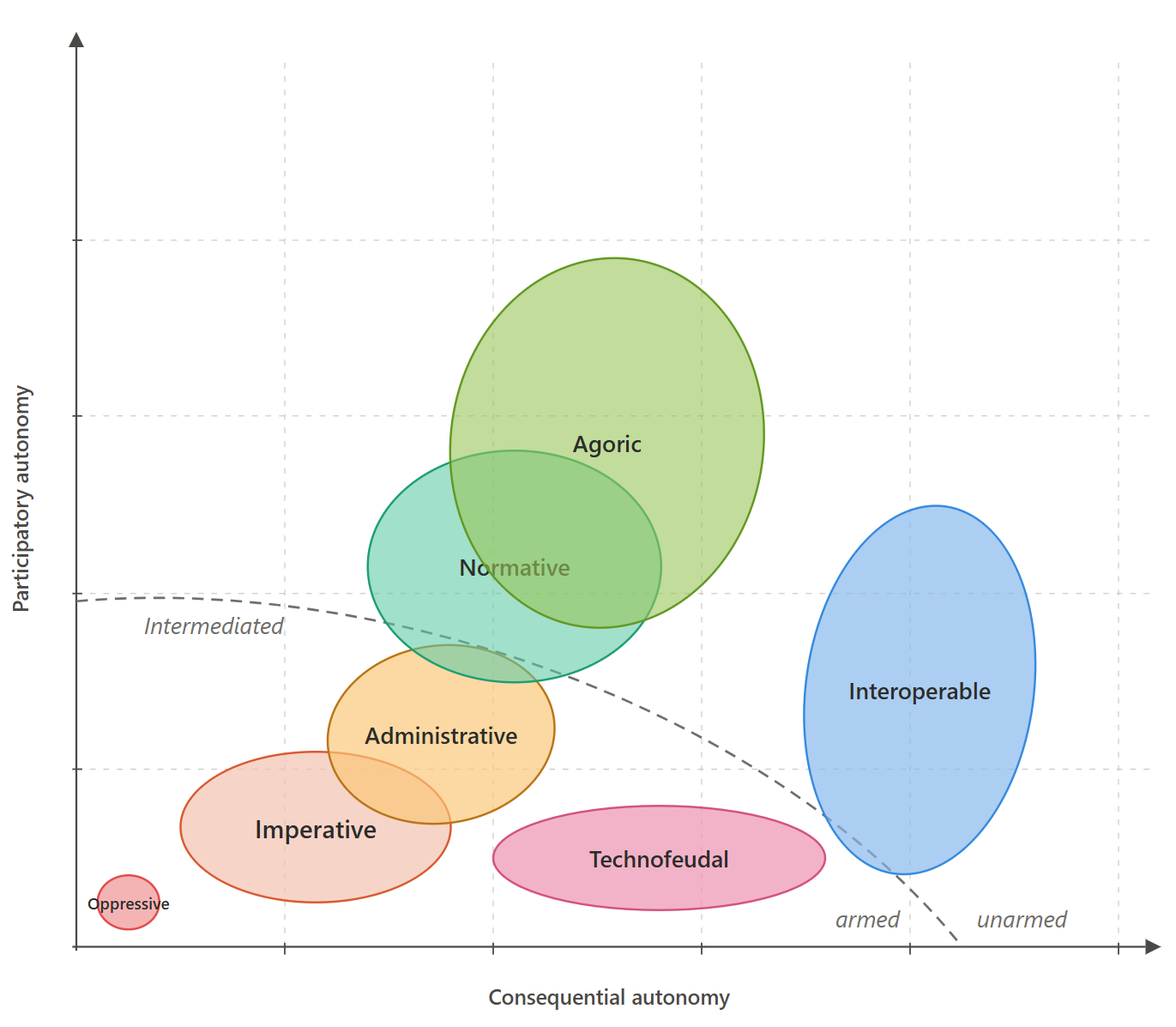
Armament is not the only thing that varies. A lease can also be active or dormant. An active lease is exercised continuously. A dormant lease is not known to exist at all until something wakes it up.
The clearest examples of active leases are the platforms. For an Amazon seller, an Uber driver, a developer in Apple’s App Store, it may feel like they freely run their private business, yet the platform sets the fees, the ranking, the visibility, and the right to remain, all revocable at will. That is an armed lease, and an active one: visible on the surface, collected every day. That is the Technofeudal zone in the Cohesion Spectrum. A distinguishing feature, as clarified in that article, is that the terms are set unilaterally and are non-negotiable. But the landlord can also kick out the tenant at any moment, as Apple did with Epic Games in 2020. That’s a reminder in case the non-negotiability is insufficient to remove any semblance of a market in that zone.
But sanctions don’t come as a surprise in the active area. They do when the lease is dormant.
The dangerous leases are indeed armed and dormant. The book Underground Empire by Farrell and Newman’s is a catalog of such leases. Every offshore “Eurodollar” is a claim on a real dollar that can only be settled through American institutions, so the world’s payment system is leased from the United States and revocable by sanction. The one-sided control sits asleep, felt as a neutral commons, until a sanction wakes it, as it did for Iran in 2012, and again in 2018. Huawei is another prominent case. Huawei’s access to advanced chips was repossessed in 2020 by a single export rule. As a result, their mobile phone business collapsed within a year.
And then there is the lease with no landlord at all. In March 2016, Azer Koçulu, an unpaid volunteer maintainer, fell out with the npm registry after it handed his package name “kik” to a trademark holder, and withdrew all of his open-source packages. One of them, the eleven-line “left-pad,” was a small, hidden dependency that caused a major disturbance when removed. It affected the pipelines of Facebook, PayPal, Netflix and Spotify, which could not compile until the registry was restored. Notice that no platform owner pulled a lever and no rent was ever charged. A commoner turned out to be powerful only by how many happened to depend on his eleven lines of code. He held a chokepoint in the last place anyone looks for one. It was an unarmed dormant lease. Admittedly weak, because the node was trivially substitutable, but a lease all the same.
So, the leased autonomy flavors make up a matrix:
An example of unarmed and active case is OpenSSL. It was maintained by a tiny volunteer team with a single full-time developer. Just like with the “left-pad” case, no one charged rent for it so it was also unarmed, but unlike the “left-pad,” it was clear that two-thirds of web servers depend on it, so it was active, not dormant. In April 2014, as a result of the Heartbleed bug, 17% of secure servers were vulnerable to attacks that could retrieve user names, passwords and credit card numbers.
If we go back from the split we started in the updated Cohesion Spectrum, we’ll end up with an autonomy taxonomy:
Neat, right? But the world is messier, so don’t fall for it. It’s a good sense-making tool, yet better use it only as a Wittgensteinian ladder. Once you climb, throw it away.
One node, two powers
A power node can be occupied by a state, a platform, or an accidental commoner. At any rate, the one who controls it holds up to two distinct powers.
The first is the power to see. Whoever sits at the junction can watch everything that flows through it. Farrell and Newman call this the panopticon effect. (Panopticon is the name for a prison design invented by the English philosopher Jeremy Bentham in the 18th century, allowing “all prisoners of an institution to be observed by a single prison officer without the inmates knowing whether or not they are being watched.”) The NSA’s STORMBREW program, revealed in the Snowden disclosures, tapped the internet backbone via a telecom partner at seven access sites in the United States and copied the international traffic passing through. Its sister program PRISM drew material straight from the big American technology firms, Google, Microsoft, Apple and the rest.
Note the link with the Huawei case, where the sanction was for doing surveillance. In fact, the US government has nothing against surveillance as such. The issue is not the practice, but the practitioner.
And here’s yet another case: the US Treasury quietly arranged to read the financial messages crossing SWIFT, which is illegal under Belgian privacy law (where SWIFT is headquartered).
These are grand schemes of infrastructure weaponization, but there are plenty of smaller cases we live with. Take your local internet provider. They can see all your traffic.
The second is the power to cut off: the chokepoint effect. When the Trump administration sanctioned eleven judges of the International Criminal Court, they lost access to services with US providers. Beti Hohler, one of the eleven judges:
As a sanctioned person, I no longer have access to American products and services, even in Europe. My Apple ID, iCloud, Amazon, Airbnb, PayPal, and other accounts have all been blocked or cancelled. These cancellations happened overnight without advance warning.
Add to this the major cases, such as those involving Iran and Huawei, and numerous smaller ones, such as that of Epic Games, mentioned earlier.
So, a chokepoint has the power to cut off a country, a company, or a person.
Exit, but bounded
A lease binds only as long as there is nowhere to go. Where real alternatives exist, the power to repossess is weak. The distance between a leased and a free autonomy is the cost of substitution.
Digital cash and decentralized money ideas and prototypes existed since the 90s. But the tipping point was the 2008 financial crisis. That’s when the old monetary order lost its legitimacy. Worse still, major banks were rescued with taxpayer money. This and the maturation of cryptographic technologies gave the initial push to the first cryptocurrencies. The demand for censorship-resistant payments combined with speculation accelerated adoption.
When Musk bought Twitter and turned it TikToxic, the available alternatives outside the intermediary boundary were few and hardly working. But in a short time, that has changed, and now tens of millions use protocols like ATprotocol and ActivityPub for microblogging (40 million on Bluesky and 8 million on Mastodon, respectively). Now this has spread to long-form blogging (Leaflet on the ATprotocol and WriteFreely on ActivityPub, among others), photo-sharing (Pixelfed), events (Mobilizon), and messaging (Germ).
EU was dependent on cheap Russian gas, but the war in Ukraine pushed the use of alternatives. The EU is still heavily dependent on US technology and services, but the Trump policy finally woke the EU up to the reality (some countries like France had been warning for years) and prompted belated measures.
And of course, we have the fresh case, the suspension of Fable 5. Hopefully this will boost interest in open-source LLMs. There are some early signs of this happening.
But forces that push every coordination regime toward places with higher coordination-rent extraction are always active.
Balázs Bodó et al in their paper on decentralization, warned about the constant threat of recentralization:
The exploitation of competitive edges leads to the recentralisation of markets into monopolies. Without governance mechanisms in place, nodes may collude, people may lie to each other, markets can be rigged, and there can be significant cost to people entering and exiting markets.
Crypto-currency movements were led by the shared value of desintermediation. But the ecosystem not just re-introduced intermediaries. These intermediaries neatly correspond to those of fiat currencies: payment wallet providers (custodians), payment gateways (like bank payment processors), smart contract platforms (clearinghouses), token launchpads (investment banks), and other gatekeepers.
The most successful decentralized alternative to X-Twitter is Bluesky. But some authoritative voices question whether they are really decentralized and warn about re-centralization.
The EU Parliament replaced Google as a search engine, but that was an easy target; no lobbying there. Let’s see if the EU institutions will be able to get rid of Microsoft and AWS. If so, which I doubt, this will be a real success. But even that might turn out to be only surface-level autonomy, since it is governed by the same kind of thinking that brought about the situation it tries to improve, as noted in this recent article.
The creation of chokepoints, according to the Second Law of Technodynamics (coming soon), happens spontaneously in all socio-technical systems left to their own devices. So it seems that finding a substitution only temporarily removes the lease.
If there is autonomy lease, is there autonomy credit or autonomy futures? Can you short autonomy?
Is the autonomy macroeconomics, autonomonetary policy, fiscal conservatism and quantitive easing?
Is there first law of technodynamics? What is of constant volume? Agency to handle "objective" complexity/variety?