

The previous essays in the series explored the dynamics of cohesion in socio-technical systems. Call that dynamics technodynamics.
Technodynamics has certain regularities. We saw some in Cohesion Spectrum and Autonomy on lease. Others are queued up for the next essay. Initially they had been planned for this one, but some questions were left open, which the introduction of technodynamics, chosen for its interesting relation with thermodynamics, makes more pressing. So, before going further, this essay tries to answer them. The good news is that the attempt produced a promising by-product: the coordination space.
The first question is what “techno” means in “technodynamics”? Obviously, it stands for “technology,” but what is technology? Does it exist only in human social systems? If not, and if animals use technology as well, what is it in human-created systems that brings specific regularities? Is it that human technologues can span space and time? Or is it that they can be appropriated?
As it turns out, these two qualities are important and consequential, but they don’t make this split. Their power and significance are only amplified by whatever makes the split.
Animal Technology
I don’t know about you, but when I think of animal technology, the first images that come to mind are sea otters cracking open a clam with a stone or chimpanzees using a stick to fish for termites. I guess this happens out of habit to narrow down technology to tool use, a habit that is generally unhelpful and even more so when the main interest is in coordination. Plenty of coordination technologies don’t involve tools.
At the simplest level, coordination is done via signal. Beyon-Davies defines signal as “patterned modulation of energy or matter along some communication channel.”
Many prey species rely on alarm calls to warn about approaching predators. Birds have distinct signals for different kinds of danger. Signaling gets more sophisticated with monkeys, especially velvet monkeys, who famously produce distinct calls for leopards, eagles and snakes, each triggering a corresponding response: climbing higher, diving into bushes, or standing up to scan the ground. Prairie dogs (despite the name, these are rodents, so nothing to do with the canis genus) go further, embedding information about a predator’s size. All these are signals for when the threats are on, but meerkats also communicate when a threat is off.
Not all signals are about danger. The honeybee waggle dance shows the direction of a food source, so it serves as a coordination technology for recruiting foragers.
Signals are synchronous coordination technology. The receivers have to be present at the same time, and with a few exceptions like elephants, not far away.
The foraging recruitment of ants, in contrast to that of honeybees, is asynchronous. When an ant finds a food source, it gets a piece and, when carrying it to the nest, leaves a pheromone trail — a phenomenon known as “stigmergy” — which other ants that stumble upon it tend to follow and, this way, also reach the food source. Stigmergy is an advanced coordination technology. Ants make changes in the environment to use it as external memory. The whole thing is quite fascinating. For example, the evaporation rate of the pheromone trails assures a better balance between exploration and exploitation, as I wrote elsewhere.
Stigmergy not only coordinates foraging but also construction work. A termite worker deposits a soil pellet mixed with pheromone. Another worker, sensing that chemical cue, adds a pellet nearby. Over time, these local feedback loops produce arches, galleries, and chimney-like ventilation shafts.
Now we finally come to tool use. First, using a stone to crack a hard cover to get to the food is not unique for otters cracking clams. For example, chimps in West Africa use stones to crack nuts.
In both cases, they use the stone as is, which invites a distinction from humans, who, since the advent of the stone axe, have made their tools. It turns out, no. New Caledonian crows craft the twigs they use to extract their prey, removing the smaller branches and forming a hook.
So, if it is not tool-making, then maybe tool possession. Still, no. In experiments, crows that had spent time making a tool were significantly more possessive of it than when given a ready-made equivalent, suggesting that labor investment increases perceived ownership. Not unique to crows either.
The only thing I find distinctive is the self-modification of the coordination technology. The distinguishing feature of language, already evident in oral language, is that we correct language with language.
Reflexivity
Language, our first distinctive coordination technology, is unique in its ability to correct itself. We use language as metalanguage. That and not the transfer of information is the essence of language. Maturana and Varela were the first to point out that no information is transferred via language:
So long as language is considered to be denotative it will be necessary to look at it as a means for the transmission of information, as if something were transmitted from organism to organism, in a manner such that the domain of uncertainties of the ‘receiver’ should be reduced according to the specifications of the ‘sender’. However, when it is recognized that language is connotative and not denotative, and that its function is ·to orient the orientee within his cognitive domain without regard for the cognitive domain of the orienter, it becomes apparent that there is no transmission of information through language. It behooves the orientee, as a result of an independent internal operation upon his own state, to choose where to orient his cognitive domain; the choice is caused by the ‘message’, but the orientation thus produced is independent of what the ‘message’ represents for the oriented.
(Maturana & Varela, Autopoiesis and Cognition: The Realization of the Living, 1980)
If language, contrary to the popular belief, is not able to transfer information, then how does understanding happen at all? Maturana emphasized the dynamic nature of language by referring to it as languaging: a coordination of coordinations of behavior in a shared consensual domain. It is the history of coordinated coordinations that makes language work, not decoding and encoding of messages. Living beings are operationally closed systems, and they can be only irritated, not instructed from outside. Language works not because it transmits, but because of its history of reflexive and recursive coordinations. We guide, correct and stabilize language with language. What do you mean, in other words, as we earlier agreed and so on. When one person’s behavior orients another, we create a continuous loop of co-orientation. Every new utterance both exploits the current “grammar” of understanding and can reshape it. Each conversational act creates distinctions that become new resources for further interactions. We can comment on grammar, preserve norms, coin new terms.
Language is not just a medium of communication between two autonomous beings, but it achieves autonomy beyond individual intention. That’s the theory of participatory sense-making, proposed first in 2007 in a paper by De Jaegher and Di Paolo and further extended in the following years and fully developed in the book Linguistic Bodies.
The reflexivity of oral language is further amplified through writing. The first true writing initially recorded economic transactions, ration distributions and ritual texts. So inscription began as a tool for social coordination, especially administration and ceremony. Once in place, writing allowed coordination on a much larger scale: laws could be codified (e.g., Hammurabi’s Code, the Torah, or Roman law), religious and historical narratives could be fixed in texts, and bureaucracies could archive decisions. Writing externalized and scaled the reflexive work done by oral culture. It allowed new meta-coordination: rules about language (grammar codified by grammarians), meta-narratives (history taught in schools), and meta-law (constitutions and written statutes) to be sustained across generations.
The printing press scaled up the production of written texts but, importantly, also reduced the drift in handwritten manuscripts, where every act of copying introduced errors. Fixing words on a page created stable reference points, where mistakes can be identified and corrected. This brought errata sheets and revised editions and the possibility for dispersed readers to participate in a common process of refinement. Maybe counterintuitively, the better stabilization did not increase conservation so much as evolvability. Books turned out to be an evolving record of collective inquiry.
Books allowed individual interpretation. They got decoupled from priests and scholars who previously provided guidance. And the need for such guidance became portable with coordination technologies for organizing information: page numbers, indexes, alphabetical order, title pages.
Maybe the most profound transformation was temporal. The printing press converted language from a medium of continual loss and recovery into an engine of cumulative social, intellectual, and scientific coordination. Reflexivity and recursivity at multiple scales across time.
With software and AI, reflexive coordination goes to another level. Software is itself a set of coordination rules expressed as code. Digital protocols such as TCP/IP, HTTP, and blockchain consensus mechanisms define how millions of humans and machines coordinate their actions. These rules are themselves open to revision through the same coordination processes they govern. Developers coordinate through version control systems, issue tracking, code review, and collaborative governance to modify the very code that structures future coordination. In other words, programmers coordinate to update the coordination code.
Software makes reflexivity operational rather than merely conceptual. Programming languages do not simply describe behavior. The code executes interactions among people, software agents and devices. Modern development environments further amplify this capacity through compilers, version control, and code-generation tools that allow software to produce or modify software. Self-modifying programs and adaptive systems can already adjust parts of their own behavior in response to feedback. AI goes a step further: AI systems themselves are increasingly written by AI.
According to Andre Reichel, all technology is autopoietic. That might be a strong claim when applied to all technologies, but for AI, it is more of a field report than a theory.
So, reflexivity distinguishes human and animal technologies, and it brings more sophisticated reflexivity. Bees cannot rewrite the waggle dance, nor can ants redesign their pheromone signaling. Humans have externalized reflexivity first to records such as books and then into durable computational artifacts whose coordination rules can be copied, inspected, revised, and deployed at planetary scale. Software, digital networks, and AI constitute a distinct tier of programmable reflexivity, where the medium of coordination is itself explicit, self-referential, and continually open to revision.
Coordination Space
Reflexivity is then one dimension for classifying coordination technologies and is the one that separates human coordination from animal coordination. Another criterion for classification is whether the participants share the same space and time. A velvet monkey or a prairie dog should be there at the same time and not too far away to hear the call of their pals. An oral utterance can function as coordination technology only if another human is present at the same time and place (taking functioning hearing as a given). In contrast, an ant can stumble upon and be led by a pheromone trail left by another ant that has gone. Some for termites. And if a speech is recorded or written, another human can listen to the record or read the transcript without the author being present, nearby, or alive.
                                        ┌─────────────────────┐
                                        │      spacetime      │
                                        ├──────────┬──────────┤
                                        │   same   │   diff   │
                    ┌───────────┬───────┼──────────┼──────────┤
                    │           │  yes  │  speech  │  record  │
                    │ reflexive ├───────┼──────────┼──────────┤
                    │           │  no   │  signal  │  trace   │
                    └───────────┴───────┴──────────┴──────────┘
We may continue this classification in various ways, applying different distinctions. Some of them will be useful, others less so. The first one that survived my current set of tests is reciprocity, keeping it, just as spacetime and reflexivity, as a binary code: missing (broadcast), present (interactive). Then our 2x2 matrix will expand into a 2x2x2 cube, defining eight elementary coordination technologies.
The oral speech will split into monologue and conversation. A monologue is still reflexive, “what I meant was...” and so on.
We get eight small cubes that make one bigger cube with dimensions: spacetime, reflexivity and reciprocity. Here’s a static view:
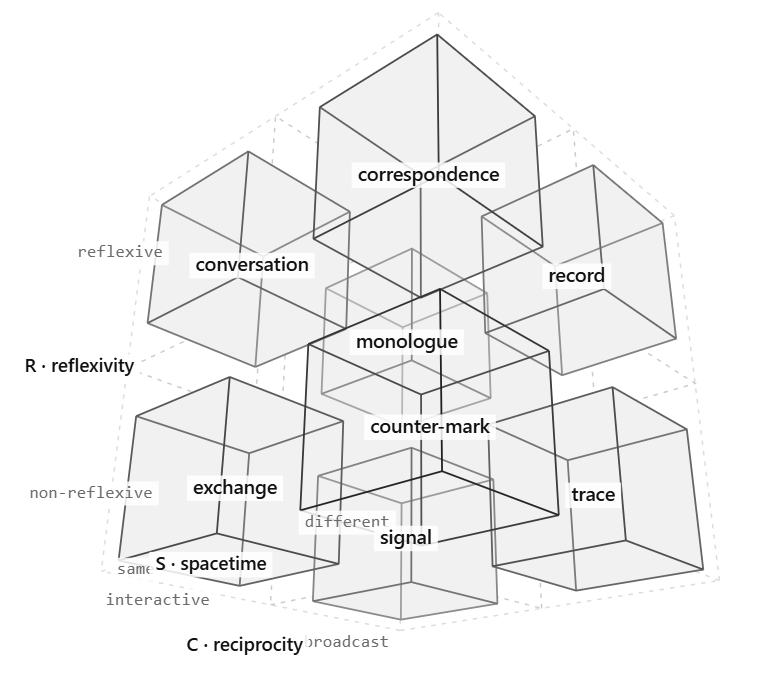
An interactive publication is available here.
One reason this model survived is that, unlike many previous attempts, it contains no uninhabited cells. All coordination technologies are widely used, and only the cube detached/non-reflexive/interactive is used sparsely. Yet, there are at least two cases: counter-marking and silent trade. Scent counter-marking is when a mammal deposits its mark directly over or beside another’s. Silent trade was once practiced by groups with no shared language, in which goods were left and withdrawn in turn until both parties were satisfied.
Trace is about stigmergy, and the paradigmatic examples are ants and termites. But stigmergic coordination occurs among humans as well, and one recent example is Wikipedia edits.
These are elementary coordination technologies, and in practice they often appear stacked.
A classroom is a coordination stack of a monologue (the lecture), conversation (discussion), a record (the textbook), and a signal (the bell). A similar stack is the courtroom, which combines a monologue (the ruling read out), conversation (argument between counsel), a record (the statute applied and the transcript kept), and signal (rise for the judge). So this is a pattern of stacks, which we can call assemblies and add church service and parliament since they combine the same four coordination technologies
Markets and stock exchanges stack a trace (prices, ticker) bound to a record (the trading or listing rules, revised more slowly) and threaded by correspondence (bids and offers between parties).
A code-hosting platform is correspondence (issues and pull requests) over a record (the code), with a trace (stars, activity signals) guiding attention.
The coordination space classifies elementary technologies, agnostic of their operation. For example, it doesn’t ask who runs the rule. Such a question will draw a distinction between enacted and executed: enacted by a living agent, or executed by an artifact once launched. And then, based on rule dynamics and re-applying reflexivity, we can distinguish between executable artifacts such as an automaton (traffic light, vending machine), a software program and AI systems which can change their own code, including the rules for changing the rules.
“Techno” in “Technodynamics”
So “techno” is about technologies because the use of technologies is what shapes the dynamics of social systems. But in human systems, these technologies are distinguished by being self-modifying, generally with a human in the loop, but now also without. And it is this distinction that gives rise to the specific technodynamic phenomenon, such as movements in the autonomy plane towards zones with higher dependencies.
But is “techno” restricted to coordination technologies? Yes and no. Yes, because coordination technologies are the main driver of the regularities in technodynamics, and no, because the other types of technologies, like production and military technologies, are, for millennia now, entangled with coordination technologies.